Plan Stability Versus Plan Optimization Tradeoffs in Annual Compensation Design
Frequent redesigns boost revenue impact, but constant change erodes rep trust and plan data quality.

Annual compensation design is a decision about how much to change, not just what to pay. Every plan sits somewhere between two failure modes: change too much and reps stop trusting the system enough to plan their own financial lives around it; change too little and the plan quietly drifts away from the business it was built to serve. Neither failure mode is safer than the other, and the real discipline in plan design is choosing, on purpose, which one an organization is more willing to risk. McKinsey has found that smart revisions to compensation models can produce up to 50% more impact on sales than an equivalent change in advertising spend, which means the quality of the design decision, not the size of the budget behind it, is what actually moves revenue.
How widespread annual plan changes have become
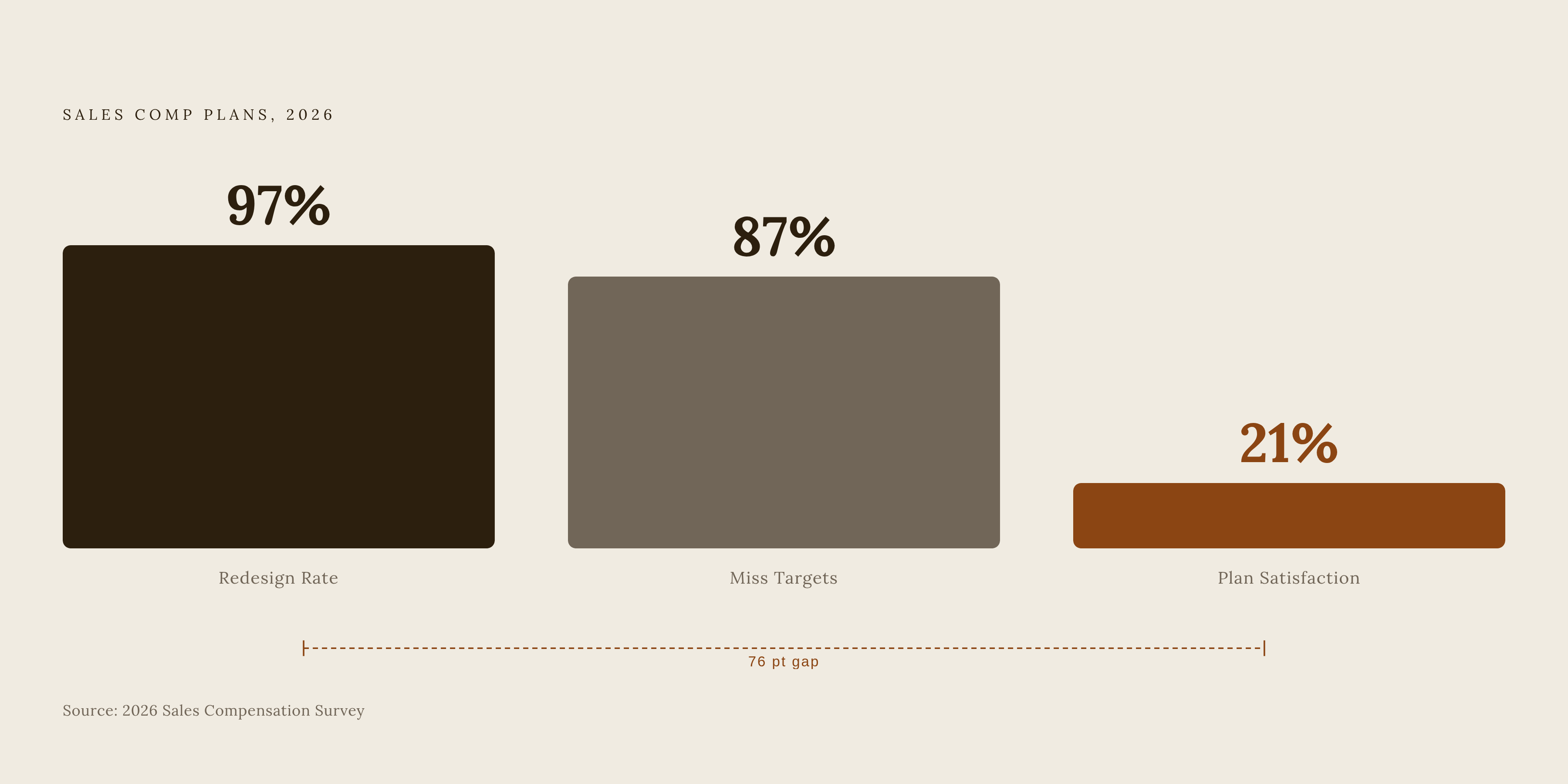
Nearly every company redesigned its sales comp plan for 2026. WorldatWork put the figure at 97%, up from 86% just the year before, which is close to universal turnover in a single cycle. The same research found that eighty percent of compensation leaders named change management strategy a key governance focus, which tells you something important: the field already knows this is a process problem, not simply a design problem.
And yet satisfaction hasn't followed the redesign wave. Only 21% of companies report being satisfied with their sales compensation plans. Xactly's 2025 research found that 87% of sales teams struggle to meet or exceed targets, with compensation misalignment cited as a primary driver. Placing those numbers next to the 97% redesign rate reveals a pattern of high change frequency, low satisfaction, low attainment. That combination suggests the industry is optimizing at the surface, tweaking rates and thresholds, without resolving the deeper structural question of how much change a plan and its reps can actually absorb in a given year.
Which raises the next question directly: what does that instability cost at the level of the individual rep?
What instability costs: rep trust, behavioral continuity, and analytical reliability
Reps read a new comp plan the way anyone reads a contract that affects their paycheck: they look for what they're about to lose before they bother evaluating what they might gain. Loss aversion is well documented in behavioral economics, and the asymmetry is large, the pain of a loss registers as meaningfully more powerful than the pleasure of an equivalent gain. A rep scanning a new plan document is hunting for the accelerator that disappeared, not doing net-present-value math. They're hunting for the accelerator that disappeared.
Change fatigue makes this worse over time. A rep who has lived through three redesigns in three years doesn't evaluate the fourth plan on its merits, they evaluate it with suspicion baked in, regardless of what the new terms actually say. That default posture is hard to undo once it sets in.
The behavioral cost compounds from there. Reps can't build a multi-quarter selling strategy when the rules governing their pipeline shift every twelve months, and morale erodes when someone can't see a stable path to on-target earnings and has to guess which quarter to push a deal into. Ramping reps carry a particular version of this problem: someone who never experiences a full cycle under one consistent plan never develops calibrated judgment about where their effort actually pays off. They're learning a moving target.
Analytical reliability breaks down alongside the behavioral kind. When plan rules shift mid-stream, it becomes genuinely hard to tell whether a change in performance reflects the plan working as intended or the market moving on its own. Year-end calculations get messy fast when different rule sets have to be reconciled across partial periods, President's Club eligibility, annual accelerators, attainment rollups all get harder to compute cleanly when two versions of the plan touch the same year.
None of this is free. Commission errors are a well-documented cost of complex plan design, and instability multiplies that risk by introducing overlapping rule sets and edge cases mid-year. The legal exposure is not hypothetical, either: documentation and auditability failures are not abstractions on a whiteboard, they are the kind of gap that ends up in a courtroom. Instability, in the end, doesn't just make reps uncomfortable. It degrades the data quality that every future design decision has to depend on.
What over-stability costs: plans that drift from the business they were built to serve
A plan built for last year's go-to-market motion can actively reward the wrong behavior this year. The structure that produces the compensation numbers determines which deals a rep prioritizes, how hard they push on price, and whether they chase a new logo or an expansion opportunity, and none of that structure updates itself just because the business changed.
Incentive misalignment across go-to-market functions is a well-documented failure mode on its own. Fullcast has noted that marketing gets measured on leads, BDRs on meetings, sales on revenue, and each function optimizes for its own metric while the system as a whole underperforms. A stale comp plan doesn't just fail to fix that misalignment, it entrenches it.
Consider how fast the underlying priorities move. Everstage's 2025 research found that more than 60% of SaaS companies are now prioritizing outcomes like renewals, upsells, and multithreaded deals as key compensation drivers. A plan still anchored to pure new-logo acquisition simply doesn't capture that shift, no matter how well it was built two years ago.
Pay mix is where this drift becomes concrete. A 50/50 base-to-variable split that made sense for a mid-market AE stops making sense the moment that AE's territory shifts to enterprise accounts with sales cycles running 180 days or longer, the variable half of their pay becomes unpredictable enough to feel punitive rather than motivating. Market benchmarks move too: the Bridge Group's 2024 SaaS AE Metrics Report puts median OTE at $190,000 with a 53:47 base-to-variable split and median quota at $800,000, up from $740,000 in 2022. A plan frozen in place loses ground on recruiting competitiveness even if nothing about it is technically broken.
Quota-to-OTE ratios drift the same way. The Bridge Group puts the typical range at 3.2x to 4.8x, and a plan stuck at the wrong end of that band is either overpaying for underperformance or asking reps to hit a number that stopped being realistic. Stability, in other words, is not the same thing as correctness. A plan can be perfectly consistent year over year and perfectly misaligned with the business at the same time.
The mechanics that are hardest to change without breaking rep trust
Not every element of a comp plan carries the same change risk. Some updates read as evolution. Others read as the company moving the goalposts after the game already started.
Raising quotas mid-year with no clear market disruption behind it sits firmly in the second category, and so does lowering commission rates in territories where reps already built pipeline under the old terms. Removing accelerators above quota is arguably the riskiest move of all, since that mechanism is what retains top performers in the first place, and pulling it signals the company wants to cap their upside. WorldatWork data puts typical above-quota accelerators at 1.5x to 2x base commission, a range specific enough that reps can do the math on what they lost the moment it changes.
Other changes land as additive rather than punitive. Adding a SPIF tied to a priority product or a new segment reads as extra upside, not a restructure. Adjusting pay mix for a newly created role, rather than an existing one, avoids the sense of a rug pull. Revising thresholds in a tiered structure is tolerated too, so long as attainment data actually justifies the change and the company explains its reasoning openly rather than dropping it into a plan document unannounced.
Role matters here as much as mechanism. SDR and BDR plans, typically 65:35 to 70:30 base-heavy, carry lower variable exposure because the variable slice is smaller to begin with. Enterprise AE plans, running closer to 55:45 or 60:40, carry longer exposure windows and a much higher psychological stake with every change, since a bigger share of that rep's income rides on the outcome.
The single most consequential decision in this category is capped versus uncapped commission. Caps protect the budget, but they consistently demotivate the reps a company most needs to keep, and changing this mid-plan, in either direction, is close to impossible to do without a real trust cost. Base salary belongs in its own category entirely: base is a retention and market-positioning signal, not a lever for motivation, and adjusting it without a clear role change or market rationale behind it confuses reps more than it moves them.
Making unavoidable mid-year changes without destroying trust
Most organizations set the plan once, at the start of the fiscal year, and mid-year changes are the exception precisely because they carry a structurally higher risk of eroding trust or inviting gaming. Reps who sense that the rules can move at any point start optimizing for the plan they have today rather than the strategy the business actually needs.
Some mid-year changes are unavoidable regardless, a quota reset after a real market disruption, a shift in product line, an acquisition that changes territory overnight. When they happen, they deserve the same governance a full annual redesign gets: modeling, formal sign-off, a real communication cascade, and a dispute process reps can actually use. Treating a mid-year change as a quick fix, patched in without that process, is exactly where trust breaks.
Any mid-year change should be one reps can see is in their interest, or at the very least, does them no harm. Add a SPIF tied to a priority product rather than restructuring the base rate. Add an accelerator above quota for reps already on pace, rather than raising the quota under them. Never revalue a deal already closed and sitting in the pipeline under the old rules, that's the fastest way to convince a rep the system is rigged against them.
Quarterly changes go further than mid-year changes and generally cause more confusion than alignment, since every change resets the behavioral clock for reps still ramping. One structural safeguard helps here: pre-commit to the triggers before the year starts. Define, in writing, what circumstance would force a change, something like "if a key conversion rate misses target for two consecutive quarters, the plan adjusts by X." Doing this up front turns a mid-year action into a pre-planned response instead of a reaction, and reps can tell the difference.
Documentation carries real legal weight here too. The methodology behind any mid-year change has to be auditable and defensible, not just communicated in a team chat message, especially with pay transparency law expanding fast. Multiple states have enacted pay transparency laws, and the EU's Pay Transparency Directive carried a transposition deadline of June 7, 2026, though only four member states actually met it. That gap tells you how much catch-up is still ahead industry-wide.
A framework for making the stability-optimization tradeoff deliberately each year
None of this produces a single correct answer. What it produces, if done right, is a defensible decision with the tradeoffs named out loud instead of buried.
Start with an audit of what the current plan is actually producing. Is attainment distributing the way it should, most reps landing in the 80 to 100% range, with top performers exceeding it and earning the accelerator that's meant for them? Are the behaviors the plan rewards the ones the business actually needs right now, new logos versus expansion, volume versus margin? And where are the disputes and errors concentrated? Given that commission errors touch 8.8% of payouts annually, a cluster of disputes around one plan mechanism is usually a sign of structural ambiguity, not rep confusion.
From there, classify every proposed change by its risk category. Is it additive, new upside, a new SPIF, or subtractive, a lower rate, a higher quota, a new cap? Does it touch existing plan participants or only new roles and territories? And can the rep it affects understand the rationale in about sixty seconds? If the explanation takes longer than that, the change is probably too complex to land without a trust cost, no matter how sound the modeling behind it is.
Set the review cadence before the plan launches, not after a problem appears. Light reconciliation should happen before every payment cycle, an operational check. A comprehensive audit belongs at least once a year, or whenever a new plan is introduced, and that's the strategic check. And the triggers for a mid-year review, as noted above, should be defined before the year starts, not improvised in the middle of it.
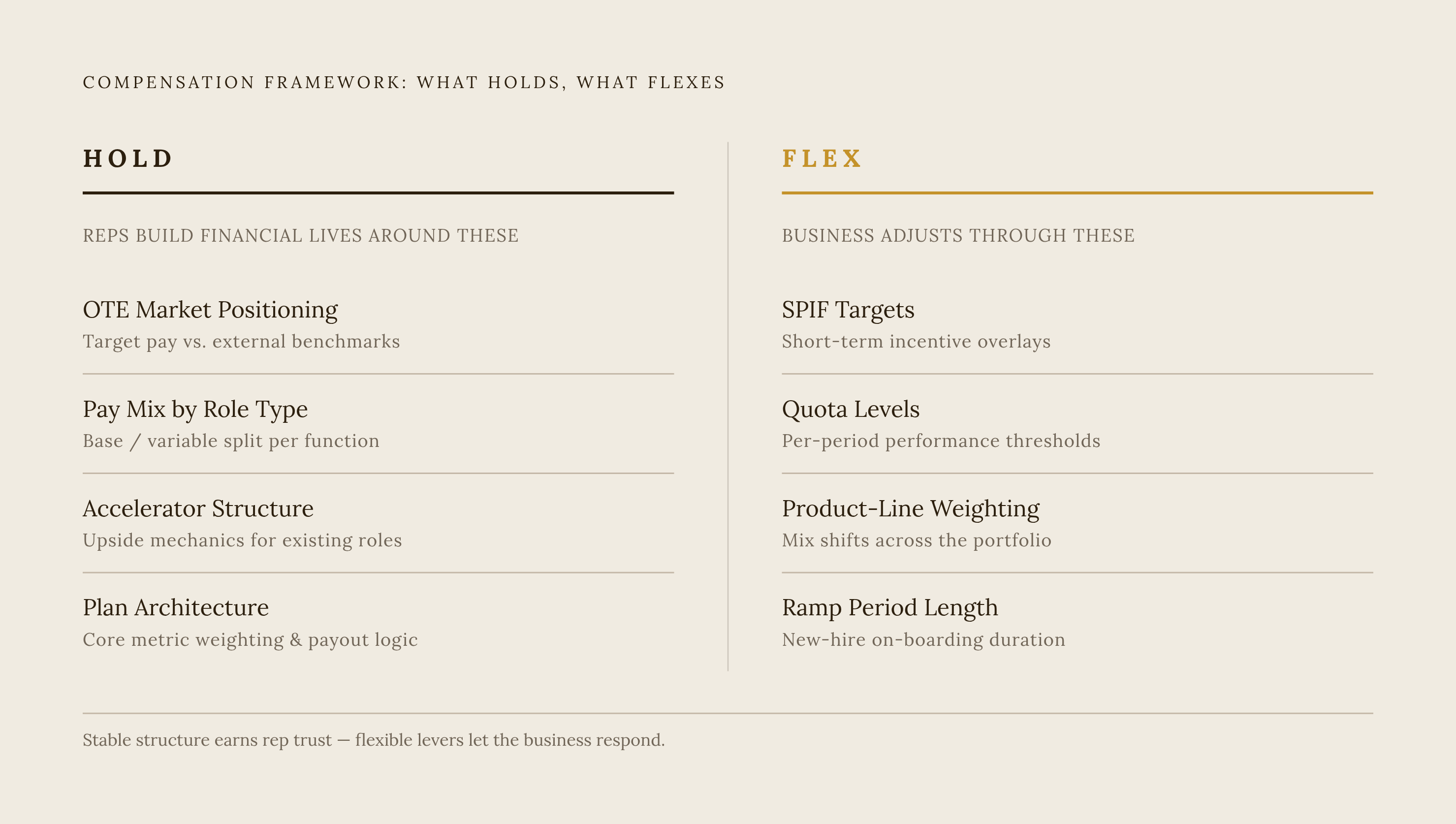
Separate what should hold steady from what should flex. OTE positioning relative to the market, pay mix by role type, and the accelerator structure for existing roles are the elements that should stay stable, and they're what reps build their financial planning around. SPIF targets, quota levels (with the rationale documented), product-line weighting, and ramp period length for new hires are the elements built to flex as the business shifts underneath them.
And document the decision itself, not just the outcome. Reps need to understand why a plan changed, not only what changed, and that's precisely where change management becomes a governance function rather than an afterthought tacked onto the rollout email. WorldatWork's finding that 80% of compensation leaders treat change management as a governance priority reflects that the communication is part of the plan, not a supplement to it. It's part of the plan.
How plan administration infrastructure shapes execution of a tradeoff decision
A well-reasoned design decision can still fail entirely at rollout if the calculation infrastructure that supports it can't handle layered rules, mid-year overlaps, or per-rep plan variants accurately. The decision and the execution are two different problems, and the second one is where a lot of good design work quietly falls apart.
CaptivateIQ's State of Incentive Compensation Report found that only 27% of companies have fully automated their end-to-end commissions process, which means most organizations are still running plan changes through spreadsheets never built to track how a plan's logic evolves over time. That gap matters most exactly when the stability-optimization tradeoff calls for change.
Spreadsheets fail in specific, predictable ways here. There's no version control for plan logic, so when a plan changes mid-year, nothing cleanly separates the old-rule period from the new-rule period without someone managing that boundary by hand. There's no audit trail, so a dispute over which version of the plan applied to a given deal has no defensible resolution path, just someone's memory of what the spreadsheet looked like in March. And formula errors cascade across multi-tier and accelerator structures, which happen to be exactly the structures that change most often during an optimization cycle.
CRM data integrity carries a parallel risk. Fields that feed directly into payout logic, deal amount, stage, close date, ownership, split percentage, renewal flags, need to be monitored for changes after a deal closes. A silent edit to one of those fields shouldn't just flow into the commission calculation unflagged.
All of this means the administration infrastructure itself sets the ceiling on how much a plan can safely change in a given year. A team running on spreadsheets has a lower change capacity than a team running on structured commission software with locked pay periods, logged approvals, and detailed per-rep statements. The stability-optimization tradeoff is an infrastructure question too, not just a design question. It's an infrastructure question too, and for a team whose calculation systems are fragile, the right answer may genuinely be less change than the business would otherwise warrant, simply because the execution risk outweighs the benefit.
What to look for in commission software when plan complexity and change frequency are design variables
The infrastructure requirements described above point to a concrete evaluation checklist. Version control for plan logic matters most: a system needs to keep old-rule and new-rule periods cleanly separated when a plan changes mid-cycle, so a deal closed under the March terms is calculated under the March terms, automatically, without someone reconstructing history by hand.
Audit trails matter just as much, and for the same reason documentation matters in mid-year changes generally. Every approval, every plan version, every calculation needs a record that can settle a dispute months later without relying on anyone's memory of what happened. That record also becomes the evidence base an organization needs if a pay transparency regulator or a rep's attorney ever asks how a number was reached.
Support for per-rep plan variants is the next test. Real organizations rarely run one plan for every rep, they run a base structure with role-based and territory-based variants layered on top, and the software has to represent that complexity without forcing someone to hand-build a parallel spreadsheet for every exception. Locked pay periods matter for the same reason: once a period closes and reps get paid, that period's calculation logic should be frozen, immune to a later edit that quietly changes what someone already earned.
None of this replaces the design work described above. It just determines whether that design work can survive contact with a live payroll cycle, twelve months of changing quotas, and a rep base that is, quite reasonably, watching every number.