Impact of Multi-Element Arrangements on Sales Commission Allocation Under ASC 606
Multi-element deals force commissions to amortize across different timelines under ASC 606.
ASC 606 changed the default treatment of sales commissions from immediate expensing to capitalization, and multi-element arrangements are what make that shift consequential for Finance and RevOps teams. ASC 606, paired with ASC 340-40's guidance on contract costs, reframed incremental costs of obtaining a contract as assets that deliver value across the life of that contract. Commission expense now has to track the timing of delivery.
A practical expedient softens this for simple deals: where the amortization period would be one year or less, companies can still expense commissions immediately. That relief holds only as long as the underlying contract is straightforward. It disappears the moment a contract bundles obligations with meaningfully different delivery timelines, because at that point no single one-year clock applies to the whole arrangement.
A multi-element arrangement is a single contract that promises more than one distinct product or service. Under ASC 606, each distinct deliverable inside that contract counts as a separate performance obligation, and revenue tied to each obligation, along with the commission cost attached to it, has to follow the delivery of that specific obligation. Consider a deal that bundles a SaaS subscription, an implementation engagement, and an ongoing support tier under one signature. Three delivery profiles sit inside one contract, and each one creates its own capitalization and amortization problem for the slice of commission tied to it. That fragmentation is the starting condition for everything that follows in MEA commission accounting.
The Standalone Selling Price Allocation Engine
The standalone selling price allocation step determines what fraction of a bundled commission gets capitalized over years and what fraction gets treated as a near-term expense, which makes it one of the most consequential calculations in the entire commission accounting process. Under ASC 606, the total transaction price gets allocated to each performance obligation in proportion to that obligation's standalone selling price relative to the sum of all standalone selling prices in the arrangement. The allocation follows the relative value of what's being delivered, not the way the invoice happens to be structured or how the sales team chose to itemize the contract.
When an observable price for an element doesn't exist, a hierarchy governs how companies estimate it. A residual approach also exists for elements with highly variable or uncertain pricing: a company can allocate whatever remains of the transaction price after every other obligation has been valued through one of the methods above. Auditors tend to scrutinize residual allocations closely, since they concentrate estimation risk into a single line.
The consequence for commission cost is direct. If a bundled deal allocates two-thirds of its value to a multi-year subscription and one-third to a one-time implementation engagement, the commission tied to that deal splits along the same proportional lines. The majority of the rep's commission on that deal becomes a long-lived capitalized asset. None of this works if the standalone selling price table behind it is stale. The table has to be maintained and updated as pricing changes, because outdated SSP inputs produce allocation errors that compound across every deal closed in the period that uses them.
The Amortization Period for a Bundled Commission
Once a commission has been allocated across performance obligations, each slice has to be amortized over its own expected benefit period, and for obligations tied to renewals or long-lived customer relationships, that period can run longer than the contract itself. The slice of commission allocated to a one-time implementation engagement is typically amortized through go-live or customer acceptance, the point at which that specific obligation is considered satisfied. The slice allocated to a multi-year subscription, or to a multi-year post-contract support arrangement, amortizes over the multi-year span of that particular obligation. These two amortization clocks can run at entirely different speeds inside the same contract.
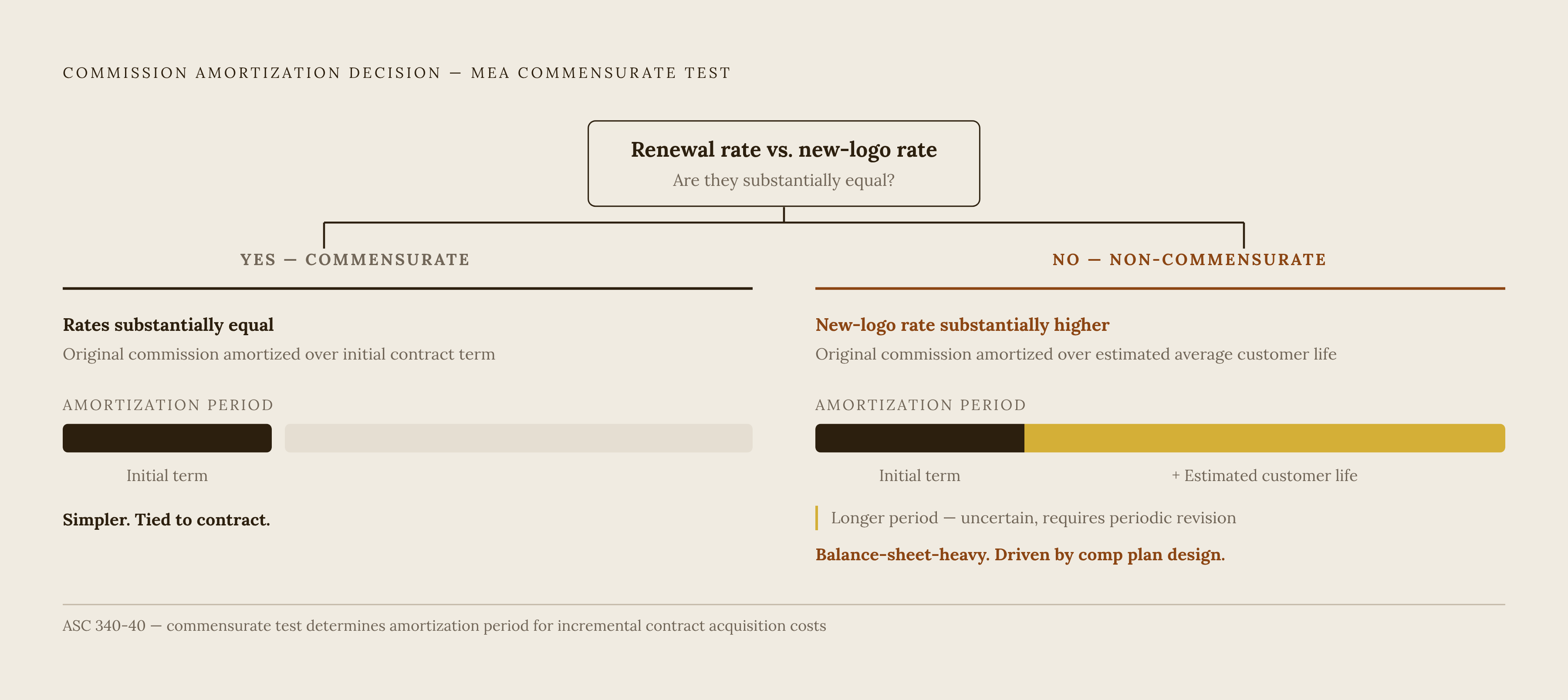
The hardest and most auditor-scrutinized question in this entire area is what practitioners call the renewal commensurate judgment: whether the commission paid on a renewal is commensurate with the commission paid on the original new-logo sale. This question deserves plain treatment, because it trips up more Finance teams than any other part of MEA commission accounting. If a company pays a sales rep a substantial commission rate on a new subscription and then pays a much smaller rate when that subscription renews, the two commissions are not commensurate with each other. That gap forces a specific accounting consequence: the original new-logo commission cannot simply be amortized over the length of the initial contract term. It has to be amortized over the estimated average customer life instead, because the low renewal rate signals that the new-logo commission was effectively compensating the rep for the full expected relationship, not just the first term. Estimating customer life introduces a forecasting judgment that didn't exist under the simpler initial-term approach, and that estimate has to be revisited as actual renewal and churn behavior accumulates.
Where renewal commission rates sit close to new-logo rates, the commensurate test is satisfied, and the company can amortize the original commission over the initial contract term alone. It is a direct output of how the commission plan was designed. A company that pays dramatically higher commissions on new logos than on renewals has built a non-commensurate structure into its compensation plan, with a direct consequence for how long that commission cost sits on the balance sheet as a capitalized asset.
Variable consideration adds a further layer. Tiered commission structures, where the rate increases once a rep clears an annual quota threshold, require the company to record commission expense at the rate it expects the rep to achieve by year end, not the rate currently in effect at the time of the sale. That means the amortization calculation for a deal closed in February may need to reflect an accelerator the rep is not expected to earn until November, and the estimate has to be revisited as attainment data comes in through the year.
Non-Refundable Upfront Fees, Contract Modifications, and the Allocation and Amortization Clock
Non-refundable upfront fees and contract modifications are routine features of enterprise deals, and each one breaks the assumption that a commission gets calculated once at close and then amortizes cleanly through to the end of the term. A non-refundable setup or onboarding fee is a useful place to start. ASC 606 does not look at what the invoice calls the fee or whether it's labeled non-refundable. It asks whether the customer receives standalone value from that fee on its own. A setup fee that only makes sense in the context of the subscription it's attached to is not a distinct performance obligation, and the revenue tied to it has to be deferred and recognized over the contract term. The commission consequence follows the same logic: if the fee itself is deferred, the commission attributable to that fee is deferred as well, and it amortizes over the same period as the fee's revenue, rather than being paid out or expensed at the point cash changes hands.
Contract modifications work differently but land in the same place. A scope increase, a term extension, or a batch of additional seats added mid-contract all trigger a reassessment: is this a new contract standing on its own, a modification of the existing one, or some blend of the two? Each answer produces a different allocation and amortization treatment for the incremental commission tied to the change. If that add-on reflects the standalone selling price of the additional seats, it's treated as a distinct new contract, and the commission on it starts its own amortization schedule independent of the original deal. Now picture the same customer instead renegotiating the scope of the existing subscription itself, folding the new seats into a restructured single obligation. That scenario forces a reallocation of the remaining transaction price across the remaining performance obligations in the original contract, and it requires a corresponding adjustment to the unamortized commission asset already sitting on the balance sheet from the original sale. The operational trigger in both cases is the same deal change. The accounting consequence depends entirely on how that change is classified.
The Triangulation Between CRM, Commission Platform, and Revenue Recognition System
MEA commission accounting fails in practice because the data required to apply ASC 606 and ASC 340-40 correctly is scattered across systems that were never built to talk to each other. Three systems need to agree with one another on every bundled deal: the CRM, where deal structure and close data originate; the commission platform, where payouts actually get calculated; and the revenue recognition system, where standalone selling price allocation and amortization schedules live. Every judgment described in the sections above, the SSP split, the renewal commensurate test, the treatment of an upfront fee, the reallocation triggered by a modification, depends on these three systems holding a consistent, current picture of the same deal.
When the systems are disconnected, that consistency becomes a manual job. An incorrect close date, a wrong deal amount, or missing line-item detail for a bundled element in the CRM propagates straight through every commission and amortization calculation that depends on it, and nothing downstream can self-correct for an error that originates at the source.
Spreadsheets fail in a specific and recognizable way given the complexity built up across the sections above. A formula error buried in a nested calculation for one obligation (say, the renewal commensurate test applied to a specific subscription tier) silently miscalculates the amortization for every deal that shares that template. None of this satisfies what an audit actually requires. Locked pay periods, logged approvals, and a traceable record of how each allocation decision was made are not optional extras when an auditor asks Finance to explain why a particular commission asset was amortized over four years rather than two. A spreadsheet, however carefully built, cannot produce that documentation on demand with any reliability.
A Connected Commission Workflow for MEA Compliance
Handling MEA commission compliance reliably requires a workflow built around the data dependencies the standards themselves create, where deal structure flows from the CRM into the commission engine automatically, and allocation and amortization logic gets configured once, applied consistently, and produces a record that can stand up to an audit. The data flow has to start at the source. Deal data, including the line-item structure for bundled elements, close dates, contract term, and any modification events, needs to enter the commission system directly from the CRM rather than through a manual export that introduces a gap for errors to slip into.
Commission rules need to reflect the obligation structure of the deal itself, not just the deal as a single lump sum. Tiered rates, accelerators, and SPIFs should be configurable at the level of the individual performance obligation, so the portion of a commission attributable to a subscription can be treated on its own terms, separately from the portion attributable to implementation services. Amortization schedules generated by the system should lock once the allocation is calculated and the amortization period is set. A change to deal terms after that point should trigger a new calculation rather than silently overwrite the schedule that already exists, preserving the history of what was known and decided at each point in time.
Modifications and churn need the same structural support. And because commission data is compensation data, it needs the same security posture as any other sensitive financial dataset: encryption in transit and at rest, tenancy scoped to the organization, and a firm policy against training models on customer data. These are the baseline for handling data of this kind.
How commission plan design choices upstream create or resolve the MEA accounting problems downstream
Many of the hardest judgments in MEA commission accounting are not forced on Finance by the standards themselves. They are created by commission plan design decisions that could have been made differently, and recognizing that connection gives RevOps teams real leverage over how much of this complexity they have to absorb. The renewal commensurate structure is the clearest example. A company that sets renewal commission rates close to new-logo rates avoids the non-commensurate judgment entirely and can amortize the related commission over the initial contract term. A company that pays dramatically more for new logos than for renewals creates a long-lived balance sheet asset and an ongoing customer-lifetime estimation exercise that has to be revisited period after period. That outcome traces back to a decision written into the compensation plan, not to anything inherent in the nature of the deal.
Tiered and accelerated structures carry a parallel risk when they span multiple performance obligations without distinguishing which obligation actually drives the accelerator. Left undefined, that ambiguity forces the company into a variable consideration estimate, projecting year-end attainment just to set the current commission expense rate. Treating it instead as a general period expense is not a simplification; it's a misapplication of the standard.
Finance and RevOps should evaluate new commission plan structures for the accounting treatment they will require, not only for how well they motivate the sales team. Documentation discipline is the thread that ties all of this together. A well-designed plan that is poorly documented, where the allocation logic between obligations was never written down or version-controlled, creates the same audit exposure as a poorly designed plan, because Finance has no way to demonstrate how the amortization schedule was actually derived. The standards reward companies that can show their work, and showing the work starts with the plan design decisions made long before a single deal closes.
Sources
- Revenue recognition: Overview of ASC 606 Prepared by:
- BLUEPRINT: A BDO SERIES Revenue Recognition Under ASC 606 Updated October 2025
- 13.4 Amortization and Impairment of Contract Costs
- How the New ASC 606 and ASC 340 Guidance Impacts SaaS Companies
- 5.2 Determining standalone selling price - Viewpoint - PwC
- The ASC 606 transition: Allocating the transaction price to separate performance obligations
- 5.6 Nonrefundable Up-Front Fees
- 8.4 Nonrefundable upfront fees