Practical Expedient for Sales Commission Amortization Under ASC 606
Your commission structure determines your amortization period and expedient eligibility.

ASC 340-40-25-1 requires an entity to recognize as an asset the incremental costs of obtaining a contract if it expects to recover those costs. That requirement is a mandate, not an election: the company has no option to keep expensing commissions as incurred. Before ASC 606, expensing sales commissions as incurred was standard practice across the software industry, and plenty of finance organizations still operate as if that habit survived the transition, but it did not. Nothing in the standard grandfathers the old approach, and nothing in the standard gives a company the option to keep expensing commissions simply because that is how it has always been done. What follows from this mandate, the choice of amortization period, the assessment of whether renewals are commensurate with initial sales, the decision to elect or forgo the practical expedient, involves real judgment. But every one of those judgments has to be made inside a framework the company does not get to opt out of, and the judgments themselves are shaped by a document finance rarely controls directly: the sales compensation plan.
What the practical expedient tests
The practical expedient under ASC 340-40-25-4 is widely misunderstood, and the misunderstanding is costly. The expedient turns on the amortization period of the asset the company would otherwise have recognized, not on the length of the signed contract. A company selling exclusively on 12-month contracts can still be ineligible for the expedient if the amortization period of its commission asset runs longer than a year, because the relevant period is driven by the expected benefit period of the commission, which can extend well past the initial term through anticipated renewals. The expedient also applies narrowly even where it does apply: it covers only costs to obtain a contract, and there is no parallel expedient for costs to fulfill a contract under ASC 340-40-25-5 through 25-8. Electing the expedient carries its own disclosure obligation. ASC 340-40-50-5 and ASC 606-10-50-22 require the electing entity to disclose that it has made the election, with some relief granted to entities other than public business entities under ASC 340-40-50-6. The more dangerous failure mode sits upstream of any disclosure question. A company that skips the amortization-period analysis altogether never computes the period, never discovers that the period would have exceeded a year, and ends up with clean-looking books and a tidy accounting policy note. That arrangement holds until a new auditor, or a buyer in diligence, asks to see the period-of-benefit memo behind the policy. At that point, there is no document to produce, and the correction runs retrospective.
How the commensurate-renewal analysis determines the amortization period
The question that decides the amortization period is narrow and specific: when a company pays commissions on contract renewals, does the renewal commission rate bear a commensurate relationship to the rate paid on the initial sale? FASB staff have addressed this directly, confirming that commensurateness should be assessed by comparing the amount of the commissions relative to the value of the contracts involved. Assessing commensurateness on the basis of the sales effort required to close the deal is not consistent with Subtopic 340-40, however intuitive that framing might feel to a sales operations team. The analysis resolves into two branches, and the branch a company lands in depends entirely on its rate table. Where renewal commissions are commensurate with initial commissions, the first commission amortizes over the initial contract term alone, excluding the renewal period, which can keep the amortization period short enough to fall inside the expedient. Where the initial commission is disproportionately larger than the renewal commission, the two are not commensurate, and the first commission must be amortized over the total expected benefit period, including the anticipated renewal. That second path typically produces a multi-year asset and disqualifies the company from the expedient. None of this is an accounting policy choice made at quarter-end. It is a factual determination, and the facts that determine it are already fixed in the rate structure of the comp plan long before anyone on the finance team opens an amortization spreadsheet.
How different rate structures produce different accounting outcomes
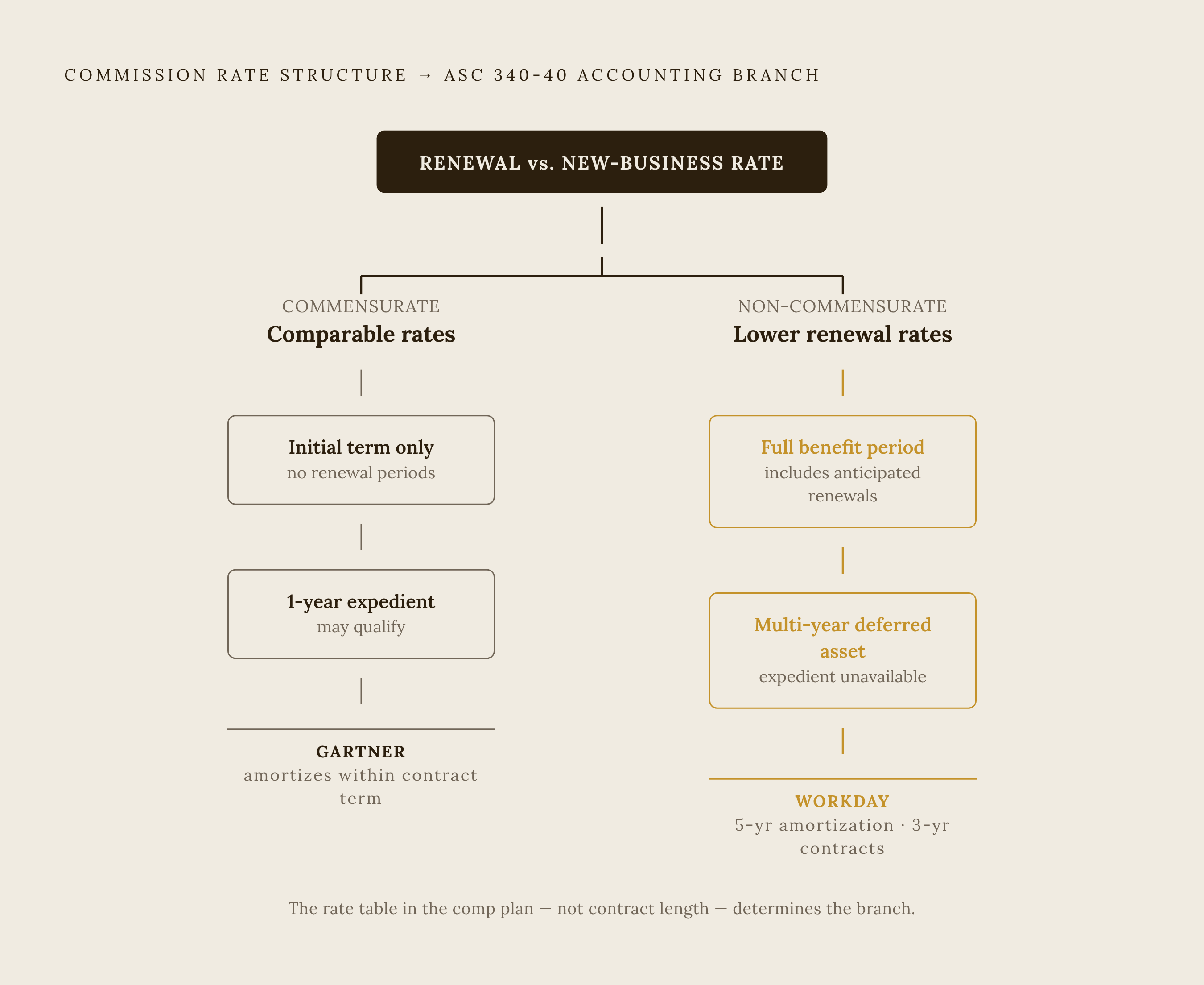
Public filings make the point better than any hypothetical could: the same accounting standard produced materially different amortization periods across comparable SaaS and technology businesses, and the difference traces to how each company structured its compensation plan, not to any company applying the rules incorrectly. Workday used a five-year amortization period against contracts generally running three years or longer, capping the period at five years on the reasoning that a three-year term plus a similar anticipated renewal period would exceed the appropriate benefit period given the pace of technology change in its market. Workday's renewal commissions were significantly lower than its initial commissions, a non-commensurate structure that required the company to look beyond the initial contract term in setting its amortization period, as reflected in its 2017 SEC correspondence. eGain took a related but distinct position, amortizing initial commissions over five years while expensing renewal commissions as incurred, citing high historical customer retention and an expected five-year technology life for its platform. In its 2020 correspondence with the SEC, eGain committed to revised disclosure stating that its renewals were not commensurate with initial sales, and the SEC closed its review without further comment. Medidata Solutions took a third approach entirely, amortizing renewal commissions over roughly twice the renewal term, on the argument that customers typically purchase incremental services at renewal, extending the benefit period beyond the renewal term itself, a position laid out in its 2018 SEC correspondence. The sharpest contrast in the group sits between Workday and Gartner. Workday paid meaningfully lower rates on renewals than on new business and ended up with a multi-year deferred asset as a result. Gartner paid comparable commission rates on each year of a contract's value, whether the sale was new or renewed, and capitalized and amortized each commission tranche within its own contract term. Both conclusions are entirely defensible under the standard. What separates them is the plan.
What comp plan design choices control the accounting answer
The rate differential between new-business commissions and renewal commissions is the single comp plan variable most directly responsible for whether a company ends up capitalizing a multi-year deferred asset or qualifying for the one-year expedient. Paying a meaningfully higher rate on new bookings than on renewals, a common structure built to reward hunters over farmers, creates exactly the non-commensurate pattern that extends the amortization period beyond the initial contract term. Paying a comparable rate across each year of a contract's value, regardless of whether that year reflects a new sale or a renewal, produces a commensurate structure and gives the company a real shot at keeping its amortization period inside the initial term, preserving its eligibility for the expedient. Enterprise account executive plans built to pay commission on Year 1 annual contract value, specifically to avoid overpaying reps on multi-year contract value that may never actually renew, create precisely the rate differential that drives a multi-year amortization outcome. That consequence is rarely considered at the moment the plan is designed, because the people building compensation plans are optimizing for sales behavior, not for the resulting accounting treatment. How commissions get triggered matters just as much as the rate itself. Plans that split commission payment between booking and cash collection, or that align commission timing with recognized revenue events, keep the commission system and the accounting system pointed at the same facts, which simplifies the period-of-benefit analysis considerably. Finance teams that review new comp plans purely for budget impact are leaving the accounting consequences of the rate table unexamined until it is too late to design around them.
Why the analysis is required when the expedient applies
A company cannot know that its amortization period runs one year or less without actually determining what that period is. CUT A company that elects the expedient without a documented period-of-benefit determination behind it has not really elected anything. It has simply failed to capitalize commissions and written a policy note that papers over the gap. This failure mode appears in SEC comment letters: a registrant discloses that it has elected the practical expedient, and when asked, cannot produce the period determination that would have justified making that election. For any team applying the expedient, the memo, the rate analysis, and the commensurate-renewal assessment are not optional paperwork completed after the fact. They are the foundation the election rests on.
Why manual tracking of commission capitalization breaks at scale
Per-rep amortization schedules, commensurate-rate assessments, renewal tracking, and period-of-benefit documentation combine into a workload that makes spreadsheet-based commission capitalization a reliable source of audit risk. A growing sales organization requires a separate deferred commission asset for every rep, every contract, and every renewal cycle, and each of those assets carries its own amortization start date, its own period, and its own commensurate-rate classification. The volume of that tracking compounds faster than a manual process can keep pace with. Compensation plan changes make the problem worse. New rate tiers, accelerators, clawbacks, or split structures each require every existing schedule to be re-examined for whether the change shifts the underlying commensurate-rate determination, and in a spreadsheet environment that re-examination typically does not happen. The resulting error conceals itself in the same way a misapplied expedient does: the spreadsheet produces a number, the number flows straight into the financial statements, and the gap between the policy memo and the actual underlying calculation only comes to light under audit or in diligence. The period-of-benefit analysis under the relevant revenue recognition standard requires commissions to align with recognized revenue rather than simply with booked deals, which means the commission system and the accounting system have to stay consistent with each other. Manual exports from a CRM into a spreadsheet cannot hold that consistency reliably as deal volume grows.
Criteria for ASC 606-Compliant Commission Software
A commission platform built for ASC 606 compliance needs to support the period-of-benefit determination itself, not just automate the payout calculation. The two functions are related, but they are not the same thing, and plenty of commission tools do the second well without doing anything for the first. Several criteria matter specifically for the capitalization workflow. The platform should classify commissions by type, distinguishing new business from renewal, and apply different amortization rules to each classification, with that distinction traceable back to the underlying rate structure in the comp plan itself. It should lock pay periods and log approvals in a way that creates an audit trail connecting each commission payment to its contract, the rate applied, and the amortization schedule that followed, which is the documentation the SEC expects to see when it asks. It should integrate directly with the CRM to ingest deal data, so the commission system and the revenue system share one source of truth instead of diverging through repeated manual export cycles. It should allow finance and the compensation team to model the effect of a proposed comp plan change on the commensurate-rate determination before that plan goes live, catching the accounting consequence at design time. And because commission records are compensation data carrying the same sensitivity as payroll records, and because those records also function as audit evidence, the platform should offer encryption in transit and at rest, org-scoped tenancy, and a clear policy against training on customer data. Pricing structured around the number of active compensation plans, rather than per-seat pricing that scales with headcount, keeps the cost of compliance tied to plan complexity, which is the actual driver of the workload, rather than to how many people a company happens to hire.
The practical steps for getting the period-of-benefit determination right
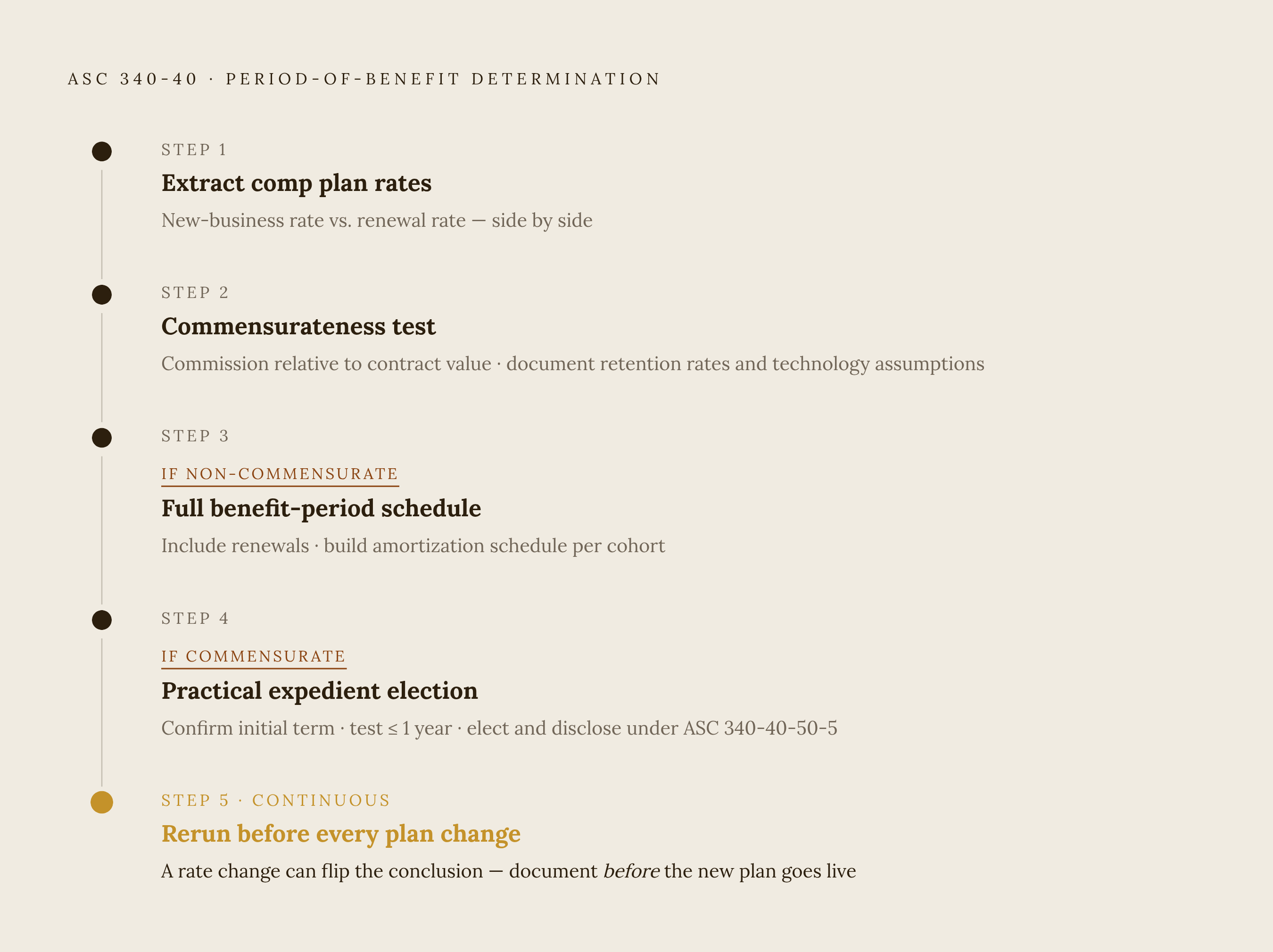
The period-of-benefit determination is cross-functional work that starts with the comp plan document itself, not with the accounting system, and the memo behind it has to be completed whether or not the company ultimately qualifies for the expedient. The first step is to obtain the current comp plan and identify, side by side, the rate paid on new-business commissions and the rate paid on renewal commissions for the same contract. The second step is to apply the FASB commensurateness test directly: compare commission amounts relative to contract value, never relative to sales effort, and document the conclusion with reference to historical retention rates and technology-change assumptions where they are relevant, in the same way Workday and eGain did in their own filings. The third step, where the rates turn out non-commensurate, is to determine the expected total benefit period including renewals and build a full amortization schedule for each new-business commission cohort. The fourth step, where the rates turn out commensurate, is to document that the period of benefit is the initial contract term, test whether that term runs one year or less, and only then formally elect and disclose the expedient under ASC 340-40-50-5. The fifth step applies continuously rather than once: every time a comp plan changes, rerun the commensurateness analysis for the affected cohort, because a rate change can flip the conclusion from commensurate to non-commensurate or back again, and that shift has to be documented before the new plan goes live. Teams migrating off spreadsheets onto a dedicated platform should run at least one full pay period in parallel across both systems, reconcile the outputs line by line, and confirm that commission classification, new business against renewal, commensurate against non-commensurate, is configured correctly before cutover. The comp plan sets the accounting outcome before the first commission check is ever cut, and the companies that treat that plan as a finance document from the start are the ones that reach the end of the year with a period-of-benefit memo they can actually defend.
Sources
- How to Account for Sales Commission Under ASC 606
- 11.2 Incremental costs of obtaining a contract - Viewpoint - PwC
- 13.2 Costs of Obtaining a Contract
- Costs to Obtain a Contract - Viewpoint - PwC
- Capitalization and Amortization of Incremental Costs of Obtaining a Contract
- The ASC 606 (revenue recognition) transition: cost capitalization
- BLUEPRINT: A BDO SERIES Revenue Recognition Under ASC 606 Updated October 2025