Earnings Predictability and Its Effect on Sales Rep Retention
Predictable commission matters more to retention than pay amount.

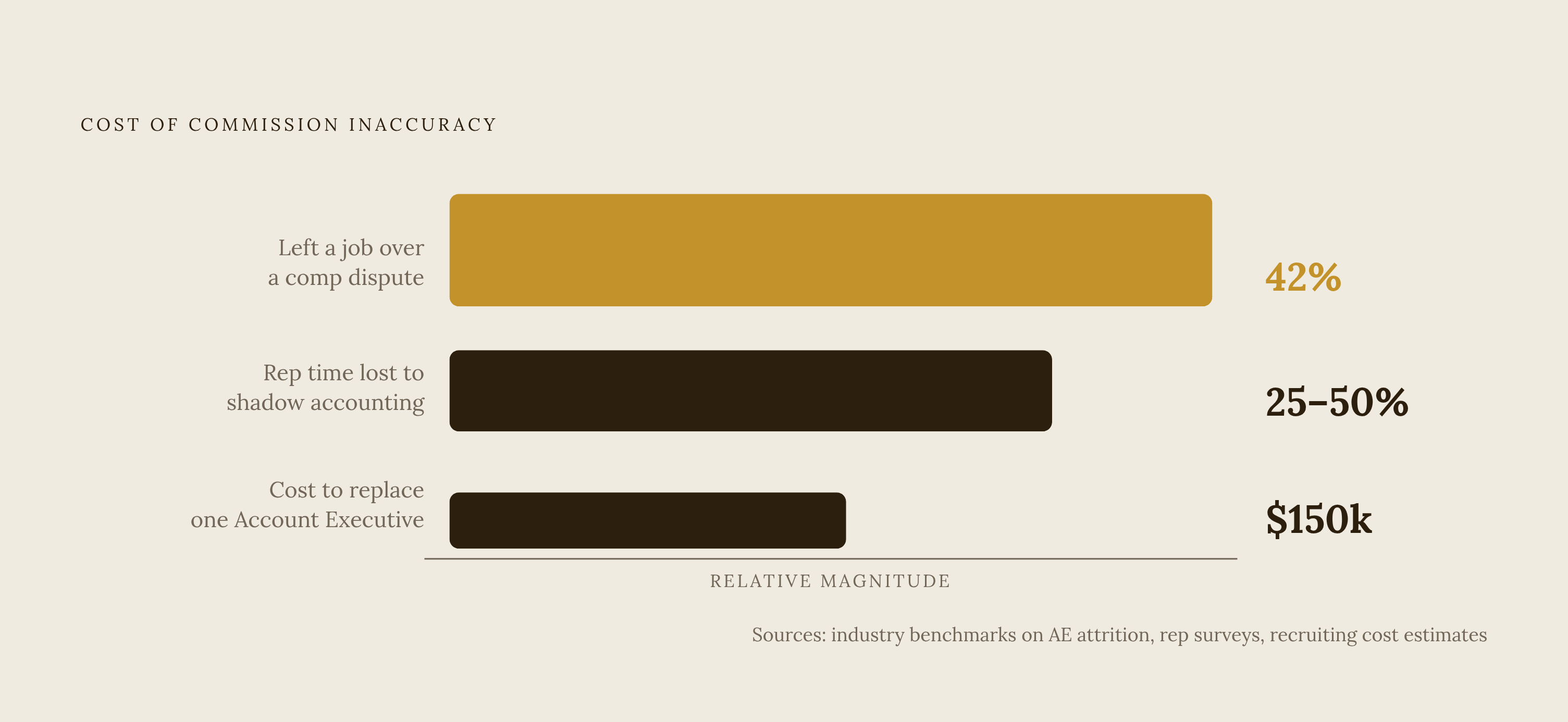
Sales rep turnover runs on money, but not in the way most compensation reviews assume. The specific driver behind a resignation is rarely the number printed on the offer letter. It's whether the number on the commission statement can be trusted, and most companies are optimizing the wrong one of those two things. Compensation tops the list of stated reasons reps give for leaving, and replacing a single Account Executive can reach up to $150,000 once ramp time, lost pipeline, and hiring costs get counted. That makes commission trust a line item, not an HR sentiment.
Research cited by Everstage found 64% of sales professionals would jump to a similar role elsewhere for better pay. Pull that number apart, though, and "better pay" splits into two separate things. One is pay quantum: the actual dollar amount on the plan. The other is pay reliability: the calculation is accurate, it arrives on time, and the rep believes the number without needing to check it. Most retention writing collapses these into one variable and calls it "compensation," and that collapse is the error. A rep earning a competitive OTE but getting hit with payout errors every other quarter is, in practical terms, worse off than a rep earning slightly less who never has to question a statement. Treating those two reps as facing the same retention risk misreads the entire problem.
Raising commission rates won't fix this on its own. Companies that reach for that lever first are solving the wrong variable, since predictability and trust operate independently of pay amount, and most organizations only pull one of the two levers available to them.
The specific mechanisms that break earnings predictability
Predictability fails in two distinct ways, and conflating them leads to the wrong fix. One is a design failure: the plan itself is ambiguous, overloaded with conditions, or gets changed mid-cycle. The other is an execution failure, where the plan is fine on paper but gets calculated wrong, paid late, or never explained to the people working under it. Companies tend to blame one when the fault lies with the other, which is how the wrong fix gets applied, and a plan redesign can't repair a broken payroll process.
On the design side, a useful design test is this: if a rep can't explain how they get paid in under a minute, the plan has too many moving parts. Commission caps make this worse. Uncapped plans with accelerators sustain motivation better than capped ones, because top performers stop pushing once they hit the ceiling. A capped plan is quietly asking the best reps on the team to slow down. Mid-year plan changes do a particular kind of damage, too: they don't just annoy reps, they invalidate whatever financial planning a rep has already built around the existing rules. In SaaS specifically, Everstage points to a common trap: front-loading commission on the initial close, with no retention KPI attached, trains reps to chase logos and ignore churn risk.
Execution failures are the more surprising category, mostly because of how common they are. Research finds commission errors touch an average of 8.8% of payouts annually, and Other data puts the scale of the problem in blunter terms: 83% of companies fail to pay commissions accurately. Miscalculation is the baseline in commission administration, not the exception to it. The causes are mundane rather than exotic: manual data entry mistakes, gaps between what the CRM says and what the commission spreadsheet says, plan logic that has outgrown the tool used to run it, and delays that can stretch to six weeks. Every added plan feature, tiered rates, accelerators, SPIFs, clawbacks, is defensible on its own. But each one is a new place where a manual process can get the math wrong, and most plans accumulate five or six of these features before anyone bothers to audit whether the spreadsheet can still hold them.
The two failure types don't stay separate for long. A complex plan run through spreadsheets is both harder for a rep to understand and more likely to produce an error, since complexity makes mistakes harder to catch during calculation. Design problems and execution problems tend to arrive together, compounding rather than canceling out.
Shadow accounting, what reps do when they stop trusting the number
When a rep stops trusting the commission statement, the first response is quieter than a complaint. It's a private spreadsheet. Reps start tracking their own deals, their own math, their own version of what they think they're owed, and checking it against whatever the company sends them. This is shadow accounting, and the Aberdeen Group found it can consume 25% to 50% of a rep's monthly time. That's time not spent prospecting, not spent on calls, not spent closing, and no sales leader would tolerate losing a quarter of a rep's month to any other task.
The productivity loss is the visible cost. The more important signal is what shadow accounting represents: the moment a rep quietly shifts from trusting the employer to auditing them. A rep who's built a tracking sheet has stopped assuming good faith and started checking for errors instead, which changes the rep's relationship to the job.
WorldatWork's data shows where this leads. About 22% of sales reps file at least one commission dispute per year, and 42% of sellers report having left a job specifically because of a compensation dispute. A single miscalculated statement can unravel months of accumulated trust, and the dollar amount of the error is often small, but the signal is not. The pattern tends to follow a familiar arc: a discrepancy surfaces, trust erodes, a dispute gets filed, and the job search often follows.
None of this is irrational behavior on the rep's part. It's a rational response to an environment where the payout can't be trusted without independent verification.
What plan design looks like when it supports predictability
A plan that supports predictability has to clear two bars at once: simple enough that a rep can hold it in their head, and stable enough that a rep can plan a mortgage or a savings goal around it without the rules shifting underneath them.
Market data gives some sense of what "normal" looks like, and that matters because reps benchmark their own plan against what they hear from peers. Talentfoot's Sales Compensation Study found most plans cluster around a 50/50 base-to-variable split. SDR and BDR roles typically run 70/30, weighted toward base since their variable component is usually tied to activity rather than closed revenue. Sales engineers and customer success managers carrying retention quotas often run 70/30 or even 80/20, reflecting how much harder their revenue contribution is to attribute directly. The Bridge Group's 2024 SaaS AE Compensation Report puts the median commission rate at 11.5% of bookings at full attainment, with a typical range of 11% to 14%, and a median quota-to-OTE ratio of 4.2x.
Certain design choices protect predictability directly, and skipping them is where most plans go wrong. Quotas set with a 60% to 80% team-wide attainment target keep the plan credible; a plan where most reps miss quota erodes morale and predictability at the same time. Accelerators for overperformance reward top performers without capping their upside. Clawback and cap provisions belong in a plan only when there's a genuine operational need for them, and when they exist, they need to be applied consistently and spelled out in writing, not invoked selectively after the fact. Mid-year changes should be off the table entirely, with plan reviews scheduled on a known annual cadence so reps aren't blindsided mid-quarter.
In SaaS and subscription businesses specifically, A practical fix for front-loaded incentives that stop at the signature is to build retention metrics like churn rate and net revenue retention directly into account manager and CSM plans. Transparency, in practice, means a single document, accessible to reps, that spells out commission percentages, the exact calculation methodology, accelerator thresholds, clawback conditions, and payment timing. Not a summary slide. The actual rules.
Even good design has limits. Fullcast's 2025 Benchmarks Report found that nearly 77% of sellers missed quota even after quotas were lowered, a reminder that design sets the conditions for predictability but can't guarantee outcomes on its own.
Why spreadsheets fail as the execution layer for commission plans
A well-designed plan is only as good as the system running it, and for most companies, that system is still a spreadsheet. Commissionly's Benchmark Report found more than 60% of small and medium-sized businesses still manage commissions this way, and CaptivateIQ's State of Incentive Compensation Management Report found only 27% of companies have fully automated their end-to-end commission process. The gap between how plans get designed and how they actually get run is exactly where predictability breaks down, and no amount of plan refinement closes it.
A typo, a broken formula, a rate table that didn't get updated, two versions of the same sheet floating between Finance and a sales manager: every manual entry in a spreadsheet is a place an error can happen. Complexity makes this worse, not better. Adding a new territory, a SPIF, or an extra accelerator tier isn't a small edit, it's a rebuild, and every rebuild is a fresh chance to introduce a mistake. Kennect's data on payout delays, up to six weeks in manual processes, points to a second dimension of the problem. Predictability isn't only about getting the number right; it's about getting it on time.
Spreadsheets also fall short on audit trail. Tools like Google Sheets' edit history or Excel's Show Changes feature can show that a cell changed last Tuesday, but they don't reliably capture why, and such features have gaps that limit their reliability as audit tools. Without a why, a dispute can't get resolved by looking at the data. It turns into an argument between whoever remembers the reasoning best, which is no way to run payroll.
The underlying mismatch is straightforward. Spreadsheets are built for static, simple data, and commission plans are dynamic and multi-condition, changing as deals close, reps cross tiers, and SPIFs activate mid-quarter. Fullcast's research points to the downstream cost: overpayments quietly drain margin, underpayments quietly drain trust, and disputes eat up Finance and RevOps time that would otherwise go toward forecasting.
What commission software changes, and what it doesn't
Fullcast frames purpose-built commission software as doing one core thing: it applies the plan's rules to deal data pulled from CRM and financial systems, and produces a calculation that's repeatable, auditable, and explainable. That sounds modest. The effects downstream are not, and this is where the software conversation usually gets oversold in one direction and undersold in the other.
For reps, the shift shows up as real-time visibility: dashboards that show quota progress, deal-level commission breakdowns, and projected earnings on demand. Reps can model how a pipeline deal would affect future earnings before it even closes, a fundamentally different relationship with pay than waiting a month for a statement to land. Locked, approved statements with a documented audit trail replace guesswork with something a rep can actually check.
For Finance and RevOps, the change is structural. The workflow runs end to end, from deal data import through plan application to a payroll-ready export, cutting out the manual reconciliation step spreadsheets require. Plans get reviewed, locked, and logged, so a dispute gets resolved against a documented record instead of two people arguing from memory. Pricing models based on the plan itself, rather than per-seat, also mean that adding headcount doesn't automatically inflate cost in a way disconnected from how commissions actually scale.
Fullcast's data shows organizations that automate commission statements see an average 38% increase in sales performance within the first year. AgencyBloc reported that MGM Benefits Group saved 80 hours a week on manual commission calculations after switching to purpose-built software, and that number makes the case for automation on labor cost alone, before trust even enters the picture.
Most vendors leave out of the pitch that software doesn't fix a bad plan. A poorly designed plan, calculated with perfect accuracy, is still a poorly designed plan. Software removes execution failures; it doesn't substitute for the design principles covered earlier, and a company that buys the tool expecting it to compensate for a broken plan will be disappointed on schedule. AI tools now entering this space can extract compensation rules from existing plan documents and surface configuration options faster than a person building a plan from scratch, but plan logic still needs a human to review and sign off. AI speeds up the work and catches mistakes. It doesn't replace the judgment plan approval actually requires.
The mechanism connecting commission execution to retention
Most retention analysis treats compensation as a design question: is the pay mix right, is the OTE competitive, is the quota reasonable. That framing misses something structural. Execution quality operates as its own retention driver, independent of anything about the plan's design, and companies that only tune design are optimizing one half of the system while leaving execution to chance.
The mechanism is simple once stated. Predictable pay lets a rep model their own financial life (a mortgage payment, a savings target, a major purchase) against a comp plan they trust. Break that trust with errors or opacity, and the plan's stated OTE, once real money in the rep's head, becomes a number on paper that may or may not show up. At that point, a rep starts treating base salary as the only real income and commission as something closer to a lottery ticket, a structurally different relationship to the job than the one the compensation plan was designed to create.
Transparency tools address a specific part of this. A rep who can see deal-level statement detail, locked pay periods, and a logged approval trail has evidence that the number is correct. That shifts the relationship from deference (taking the company's word for it) to verifiable trust: checking the record and finding it holds up. Everstage's research notes that reps resist plan changes that threaten income stability, so clear communication of new plan logic, paired with accurate execution from day one, changes whether reps trust the plan in ways communication alone can't manage.
Burnout compounds all of this. Gartner's data puts seller burnout at 90%, and shadow accounting, dispute management, and pay uncertainty stack as friction on top of a role that's already demanding by default.
Culture initiatives, recognition programs, better management training, tone-setting from leadership: none of it substitutes for structural reliability in the payout process. A rep who genuinely likes their manager but doesn't trust their commission statement is still a retention risk, because the distrust lives in the paycheck, not the relationship. For RevOps and Finance, that means commission accuracy and transparency aren't back-office efficiency metrics to report quietly upward. They're retention inputs, and they belong in the same conversation as pay mix and quota design when the question on the table is why reps leave.
The companies closing the retention gap are doing both halves of the work at once: designing plans reps can actually understand, and building an execution layer accurate and visible enough that trust becomes something a rep can verify rather than something they're asked to assume.