IFRS 15 Versus ASC 606 Treatment of Sales Commissions for Multinational Teams
Where the two revenue standards diverge on capitalizing commissions.

Sales commissions used to be a one-line expense recognized the moment a deal closed. Under IFRS 15 and ASC 606, that commission becomes an asset on the balance sheet, amortized over a period finance has to calculate and defend. The two standards agree on nearly everything about how that calculation should work, but the places where they disagree create real compliance exposure for any company reporting under both regimes at once, and sales compensation design choices made long before a contract is signed determine which side of that exposure a company lands on.
Why IFRS 15 and ASC 606 exist
Revenue recognition used to be a patchwork. Companies in different industries, and companies operating across different borders, booked revenue on inconsistent timelines and under inconsistent criteria, which made it genuinely difficult for an investor to place one company's financial statements beside another's and trust the comparison. ASC 606 and IFRS 15 were built to close that gap: ASC 606 took effect for public companies for fiscal years beginning after December 15, 2017, and for private companies after December 15, 2021 (the original private-company deadline of December 15, 2018, was extended by FASB), while IFRS 15 became effective for annual reporting periods beginning on or after January 1, 2018, applied uniformly with no separate timeline for public versus private entities.
Both standards run on the same five-step model: identify the contract with a customer, identify the performance obligations within it, determine the transaction price, allocate that price across each obligation, and recognize revenue as each obligation is satisfied. That five-step architecture is the structural core shared by both regimes, and it is the reason the two standards are described as substantially converged rather than as two separate systems that happen to resemble each other. Both standards also treat sales commissions the same way at the conceptual level: a commission that is incremental and that the company expects to recover must be capitalized as an asset and amortized over time. That shared premise is what makes the divergences discussed later in this piece meaningful departures from common ground, rather than arbitrary distinctions between two unrelated rulebooks.
What the capitalization mandate requires of commission accounting
Capitalizing a sales commission is not a policy choice a company gets to make. Wherever a commission meets the incremental and recoverability conditions and the practical expedient does not apply, both standards require capitalization. ASC 606 states that costs to obtain a contract that are incremental and expected to be recovered must be recognized as an asset, and IFRS 15 sets the same expectation.
The test that governs this is counterfactual and binary: would the company still have incurred this cost if the customer had walked away the moment before signing? A sales commission passes that test cleanly, since the company would never have paid it absent the signed contract. Legal fees and travel costs typically fail it, since the company would have incurred them regardless of whether the deal closed. That distinction is what separates a cost finance must capitalize from a cost finance can simply expense.
Applied to an actual deal, the mandate works like this: if a rep earns a commission on a three-year contract, the full commission is capitalized at signing and amortized across the three-year term instead of being expensed in the year the deal closed. That is the central operational shift from pre-2018 practice, when the entire commission would have hit the books in the year the rep earned it. The capitalization requirement extends further than the base commission itself. Employer payroll taxes and benefit costs calculated on that commission are subject to the same capitalization treatment, under the same counterfactual logic, because those costs also would not exist without the contract. Nor does the timing of the actual commission payment change any of this: the full earned amount is capitalized at contract execution regardless of when cash actually moves to the rep.
The amortization period itself is not simply the contract's stated length; it is the expected period of benefit, which can extend well past the initial term if the company anticipates renewals. A company selling twelve-month contracts that expects customers to renew, and that pays a lower commission rate on those renewals, may find its true amortization period runs longer than a year. That detail matters considerably for a provision discussed later: the practical expedient that lets companies skip capitalization altogether when the amortization period is short enough.
Finance teams managing dual IFRS and ASC 606 compliance have to track, for every contract, the commission amount, the amortization schedule tied to it, its impairment status, and the capitalized payroll tax sitting alongside it, a volume of interlocking detail that overwhelms a spreadsheet fairly quickly. Commission platforms built for this kind of work, Quota Queue among them, pair configurable compensation rules with auditable workflows and locked pay periods, which keeps capitalized commission calculations consistent and traceable across both regimes without manual reconciliation at quarter-end.
Where the two standards genuinely diverge on commission costs
IFRS 15 and ASC 606 share a five-step model and a common capitalization mandate, but four specific areas produce real, audit-relevant differences that multinational finance teams have to manage simultaneously.
The first divergence concerns impairment loss reversal. US GAAP does not allow a company to reverse an impairment once it has been recognized on an asset tied to the costs of obtaining or fulfilling a contract. IFRS 15 requires that reversal when the conditions causing the impairment improve. The same underlying deterioration in a contract's recoverability therefore produces two different outcomes depending on which book it lands on: a permanently written-down asset under ASC 606, and a fully recoverable asset under IFRS 15. A multinational group's consolidated books and its local books can end up carrying materially different balances for the exact same contract, and reconciling that gap becomes a recurring task at every close.
The second divergence sits in the collectibility threshold. Both standards require that collection of consideration from the customer be "probable" before a contract qualifies for recognition, but US GAAP and IFRS interpret "probable" differently. That difference carries straight through to commissions, since no revenue recognition means no capitalizable commission asset exists for that contract. A contract that clears the IFRS 15 threshold but fails the ASC 606 threshold generates a commission asset on the IFRS books and nothing on the GAAP books for the identical transaction. The effect compounds across a portfolio of customers in emerging markets or with thin credit histories, where collectibility judgments are inherently harder to make, and dual-reporting groups need an explicit, documented reconciliation between the two thresholds rather than an informal understanding among the accounting staff.
The third divergence is a gap in how prescriptive each standard is willing to be. US GAAP gives detailed guidance on amortizing and impairment-testing capitalized costs, including specifics on the period over which those costs should be amortized. IFRS 15 is more principles-based, offering less explicit direction and demanding more judgment about whether a given cost should be capitalized or expensed. For a multinational finance team, that means building an internal policy framework under IFRS 15 to answer questions ASC 606 would simply answer directly, and that self-authored framework creates real risk of inconsistent application across subsidiaries operating in different jurisdictions. Commission programs vary considerably from one industry and company to the next, so this principles-based gap shows its sharpest edges in non-standard plan structures: tiered accelerators, multi-level overrides, and channel commissions, none of which have explicit IFRS guidance resolving how they should be treated.
The fourth divergence concerns commissions paid to managers and on overrides rather than to the individual rep who closed the deal. One view holds that commission expense for supervisors should continue to be recognized immediately, outside the scope of ASC 606 capitalization. Deloitte's guidance takes the opposite position, concluding that commissions at the rep, manager, and regional-manager level are all capitalizable as long as the payment is driven by the specific contracts obtained, since the standard does not differentiate by title or function. This is not a settled academic debate. Workday disclosed to SEC staff that it had capitalized sales-management and sales-consultant commissions tied to specific contracts, and the staff asked directly about that treatment, confirming this as an area of active SEC scrutiny. Multinational teams need to decide, in writing, which view they apply under each framework, and hold that policy consistently. Applying different treatment to the identical override commission on the IFRS and GAAP books, without a documented rationale explaining why, is the kind of inconsistency an auditor is trained to find.
How the practical expedient works
Both standards offer a way out of capitalization entirely, and getting the exact statutory language wrong is where most misapplications of the expedient begin. ASC 340-40-25-4 permits a company to expense the incremental costs of obtaining a contract as incurred, rather than capitalizing them, if the amortization period of the asset the company would otherwise have recognized is one year or less. IFRS 15.94 states the same rule in substantively identical terms. The expedient runs on the amortization period of the asset, not on the stated length of the contract, and that single distinction is where most misapplications begin.
Consider a company selling twelve-month subscriptions that expects a meaningful share of customers to renew, and that pays a materially lower commission rate on those renewals than on new business. The true amortization period for that company's commissions extends beyond one year, because the initial commission is effectively doing work that spans the renewal period too. That company cannot use the practical expedient. But if the finance team never builds the amortization schedule in the first place, it never calculates the period that would have disqualified it, and the misapplication produces books that look entirely clean on their face. There is no exception report generated for a calculation nobody performed. The error conceals itself precisely because skipping the capitalization step looks, from the outside, identical to correctly qualifying for the expedient.
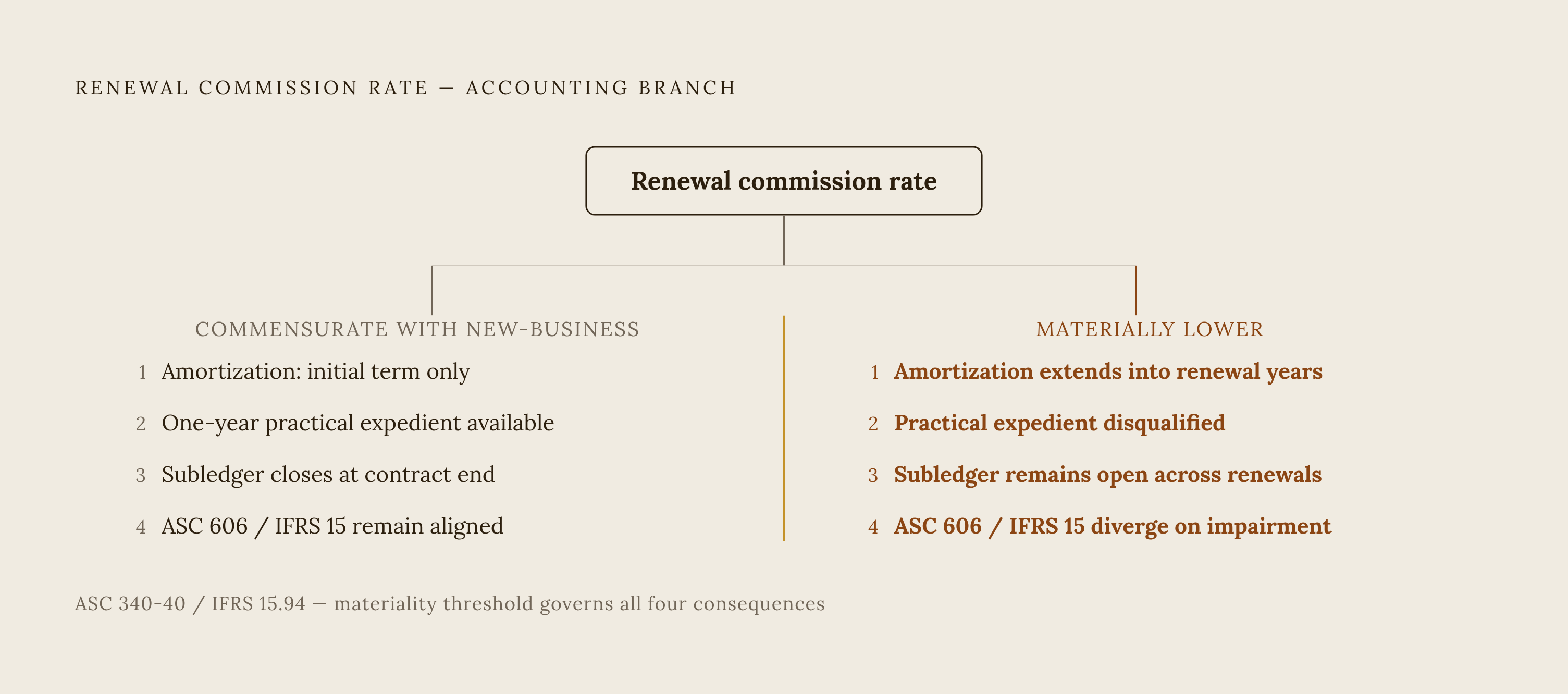
Renewal commission rate design sits at the center of this problem, and it belongs to accounting policy as much as it belongs to sales compensation design. Whether renewal commissions are "commensurate," meaning reasonably proportional to the value of each renewal contract, determines how long the amortization period runs. When renewal commissions are commensurate with new-business rates, the initial commission's job ends with the initial term, because each renewal is effectively buying its own fresh commission. When renewal rates are set materially lower than new-business rates, the initial commission is understood to be compensating the rep for the renewal periods too, which stretches the amortization period and disqualifies the company from the one-year expedient.
Both IFRS 15 and ASC 606 apply this same expedient logic without meaningful variation between them. A company that misapplies it is non-compliant under both frameworks at the same time. There is no hedge available by virtue of reporting dually. When impairment reversals or collectibility reassessments trigger a recalculation under one standard but not the other, that recalculated and re-amortized commission has to be tracked separately by reporting regime going forward, a task that becomes close to unmanageable without a rules engine and approval workflow built for exactly this kind of dual-track commission data.
How compensation plan design decisions create accounting obligations
The structure of a compensation plan, specifically its renewal commission rates, its tiered accelerators, and its multi-level overrides, settles most of the capitalization and amortization questions before finance ever opens a subledger. The plan itself is the accounting decision. Everything finance does afterward is implementation of a choice sales leadership already made.
The renewal commission rate relative to the new-business rate is the single most consequential variable in this whole picture. Where renewal commissions are commensurate with new-business commissions, reasonably proportional to the value each renewal represents, the initial commission amortizes over the initial contract term only, since each renewal period is effectively self-funding through its own proportionate payout. Where renewal commissions are set materially lower, a common design among SaaS companies that pay aggressively on new logos and little or nothing on renewals, the initial commission has to be amortized over an expected benefit period that reaches into those renewal years. That extended amortization period lengthens the life of the subledger entry and removes the one-year practical expedient as an option. The rate decision belongs in front of finance before a plan goes live with the sales team, because the accounting outcome gets settled in a sales leadership meeting whether or not anyone from accounting was in the room.
Tiered accelerators and quota-threshold uplifts carry their own capitalization obligations, and the uplift portion above the base commission rate is not automatically eligible for immediate expensing. Deloitte's guidance identifies two acceptable allocation methods for handling tiered accelerator structures, and expensing the entire uplift portion outright is not among them. A company running an accelerator program needs to apply one of those two accepted methods rather than defaulting to the simplest treatment available.
None of this is abstract for the teams building these plans. A quota structure, an accelerator curve, and a renewal rate schedule are compensation design choices, and under IFRS 15 and ASC 606 they are simultaneously decisions about asset recognition, amortization length, and audit exposure. Commission calculation platforms that model these rules directly, letting finance see the downstream amortization and capitalization consequences of a plan before it launches, close the gap between the sales leadership meeting where the rate gets set and the accounting close where that rate's consequences finally show up. Quota Queue is one such platform, built around configurable commission rules that can surface exactly this kind of compliance consequence at the plan design stage. For a multinational team running the same compensation plan through two reporting regimes at once, that visibility turns a policy decision into something made once, documented, and defensible, rather than a compliance problem discovered at the worst possible point in the close.