Plan Complexity as a Driver of Commission Administration Cost
Complex commission rules interact in ways that multiply administration work, errors, and disputes.

Commission plan complexity raises the cost of administration because each new rule affects other rules in ways that someone must track, explain, and defend. Tiers, accelerators, clawbacks, splits, and true-ups do not merely make calculations harder. In manual environments, they compound reconciliation work, payout errors, and audit exposure. Keeping that cost down starts with how the plan is designed and depends on systems that let people trace the complexity the plan needs.
Why commission plan complexity compounds administration cost, not just calculation effort
A new rule must work not only on its own but also in combination with the rules already in place. Each combination creates another circumstance in which a payout may need different treatment. Administration therefore extends beyond applying the right rate to checking which conditions apply together and whether a later event changes an earlier result. The work expands with the interactions between rules.
Consider tiered commissions combined with deal splits, clawbacks for cancellations within a 90-day window, and quarterly true-ups against quota. Together, these rules can call for thousands of separate calculations per pay period, even before a mid-cycle amendment or territory reassignment. A retroactive accelerator adds another dependency by requiring prior commissions to be recalculated when attainment crosses a threshold. One event can reopen many completed calculations. The administrator must then account for how that change affects the other provisions attached to those deals.
The shift toward retention economics makes these interactions more common in 2026. Account Executives managing recurring revenue may encounter one commission rate for new ARR, another for renewals, and a third for expansion. Those distinctions reflect real strategic intent. Yet each difference adds another variable to the combinations someone already has to track. A plan can become more closely aligned with the business while becoming substantially harder to administer.
How plan design decisions create administrative load before a single calculation runs
The work of administering a plan begins when it is written. Each measure, tier, and exception commits the organization to maintaining the data and resolving the cases needed to apply it. Treating it solely as an operational problem leaves the underlying source untouched, because administrators cannot remove obligations that the plan has already promised to reps.
Quota tiers require attention to whether and when a rep crosses an attainment threshold, while retroactive accelerators require previously processed deals to be reopened. Clawback rules create separate liability timelines across product types. Credit splits that involve a primary rep, an overlay, and a manager override call for three calculations side by side, each of which could lead to a dispute. Multi-product rate cards add a dependence on accurate product classification, so a mislabeled deal can silently receive the wrong rate. Multiple roles or product lines for the same rep compound these obligations further.
Plans are patched to accommodate new requirements while retaining provisions built for a business model the organization has outgrown. Each amendment may make sense on its own, but the work it adds depends on all the rules already in place. The first cost-reduction lever is therefore plan design. A straightforward plan that can be administered accurately is preferable to a sophisticated margin-based, multi-metric plan that repeatedly produces hours of administration and payout disputes. The trade-off is between how closely the plan serves the strategy and how much work it takes to make the plan work reliably.
What happens to error rates and administration time when complexity runs through spreadsheets
Formula drift can cause complex rules to fail without anyone noticing. An unprotected formula cell can be overwritten, and a typo in a nested IF statement can miscalculate an entire column of payouts. Retroactive accelerators make that weakness particularly consequential because they reopen rows already treated as complete. The damage may remain hidden for pay periods. It can emerge only when the retroactive pass exposes the altered formula or a rep challenges the result.
When two ops managers work on separate workbook copies, merging their changes can reintroduce errors that were already corrected. Distributing tier rates, accelerator thresholds, clawback rules, and exceptions across different files makes the authoritative rule harder to identify. Split calculations then spread the consequences across contributors. An error affecting one rep’s allocation can also affect another rep’s payout, widening the dispute beyond the original mistake.
The absence of an audit trail makes resolution expensive. A final payout number does not explain which rules ran, which data they used, or who adjusted the result. Clawbacks require time-stamped deal and cancellation records, so a workbook without that history cannot reliably enforce a 90-day window across hundreds of deals. Errors in the inputs make these weaknesses worse even when the formulas are correct. An outdated contract value, an incorrect closed date, or a mislabeled product can trigger the wrong payout, quota period, or rate, leaving administrators to reconstruct both the rule application and its source data.
The cost that lands on sales reps: shadow accounting and eroded motivation
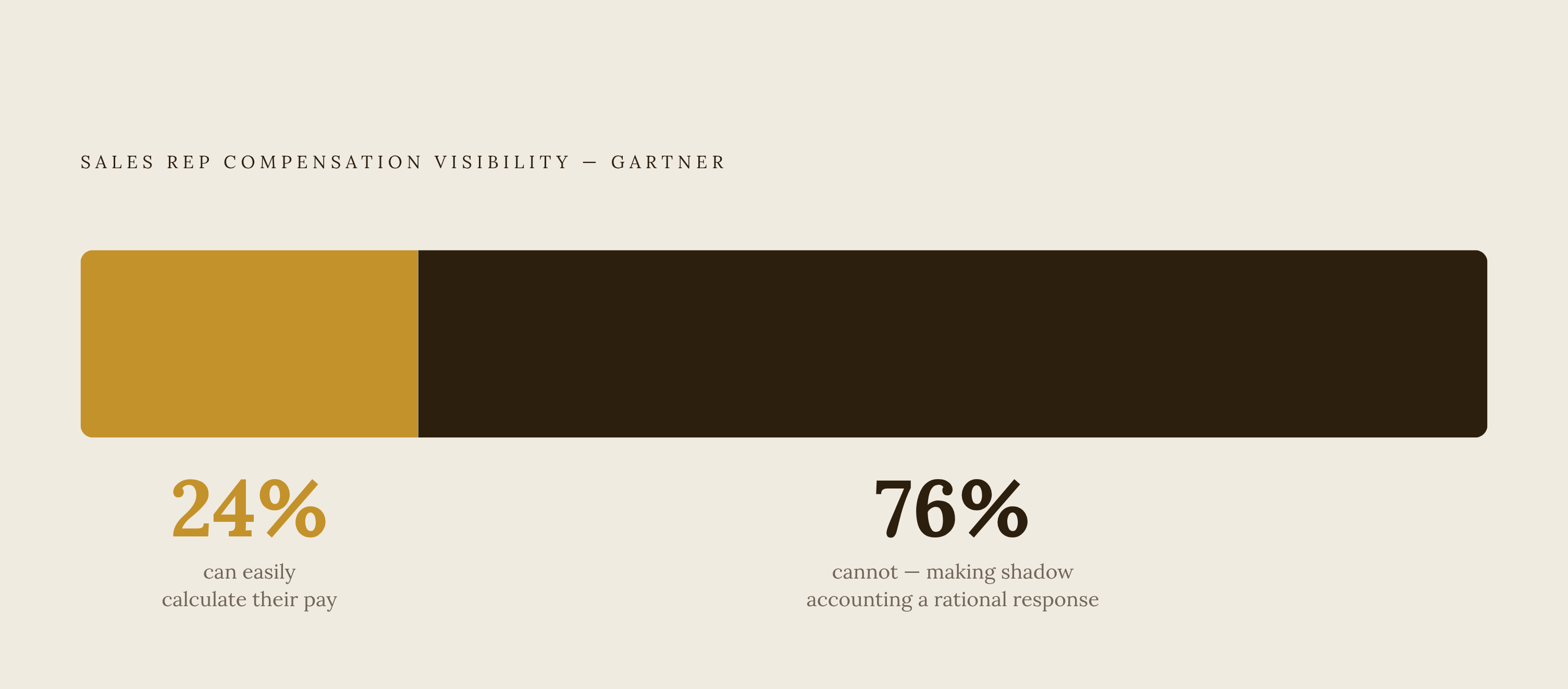
Unverifiable payouts export administration work to the sales force. A rep who has been shorted has a reason to maintain a private tracker, compare every payslip against it, and escalate discrepancies. That behavior is shadow accounting, and its cost is time diverted from selling. The commission plan still creates behavior, but not the behavior it was designed to reward.
Gartner’s research found that only 24% of sales reps can easily calculate their total variable compensation. If reps cannot understand what they will earn, the plan offers a less usable signal about which work to pursue. Private reconciliation adds a separate, recurring time cost. Each representative spends hours every week checking earnings that could have gone toward working opportunities, so distrust adds to the work of running the plan.
The same uncertainty can affect retention. Top performers may leave for competitors with clearer plans, while reps who cannot understand their earnings or regard quotas as unrealistic may disengage. Treating shadow accounting as a discipline problem misses its cause. It is a rational response to information asymmetry, particularly after a payout error gives the rep evidence that independent checking is necessary. Closing that information gap takes away the practical reason for private reconciliation, though reps may keep the habit after the process itself is correct.
The cost that lands on Finance and RevOps: reconciliation cycles, disputes, and audit exposure
Finance and RevOps absorb the correction work that private rep trackers cannot resolve. Each disputed clawback, split-credit disagreement, or retroactive accelerator recalculation can trigger another adjustment cycle. These cycles consume time without advancing the incentive plan’s purpose. Rising dispute volumes are therefore a lagging indicator of complexity overload, reflecting obligations that the operating process can no longer resolve cleanly. By the time the pattern becomes visible, administrators are already spending capacity on past payouts.
The burden extends beyond finding a replacement number. A disputed result must be explained well enough for the rep and the teams responsible for payment to accept it. Where the calculation record is incomplete, that explanation requires reconstructing the relevant data, rules, and adjustments. Resolution becomes its own administrative workload. As corrections accumulate, less time remains for plan design, analysis, and rep enablement, which are the activities that could improve the process.
ASC 606 raises the stakes beyond payout accuracy. For compliance, the commission system needs contract duration, start date, and schedule data alongside the deal amount. Those details form part of the audit record, and a simple spreadsheet-based approach does not provide the required traceability merely by producing a payment total. A correct total is not sufficient evidence. Finance must be able to connect the commission result to the contract information behind it, which makes administration infrastructure a concern for both the CFO and sales operations.
What organizations that manage complex plans well do differently
Organizations that manage complex plans effectively separate plan sophistication from administrative disorder. They can retain nuanced incentives while governing how rules are maintained, applied, and changed. Centralized plan logic is the starting point. When rules reside in a single system of record, a rate change does not depend on someone finding and updating every separate copy. This organizational choice removes the ambiguity created when different teams work from different versions of the same promise.
They also replace periodic exports with connections between calculations and live CRM records. A deal closing triggers a calculation against the record that drives the business, and a contract value change triggers recalculation. This closes the latency gap at the source. The choice is not simply to move data more quickly, but to avoid maintaining an independent commission dataset that drifts away from the underlying deals. Accurate rules cannot compensate for stale inputs.
They take the same care with plan changes as they do with source data. Effective-dating and version control allow an amendment to take effect from a specified date without rebuilding the model or obscuring the rules used for earlier payouts. Historical calculations remain defensible, and the amendment’s effects can be traced forward. Change becomes explicit rather than buried in a workbook. This preserves the distinction between a new policy and a correction to an existing calculation.
Reps receive deal-level visibility as part of that governed process. A statement they can inspect in real time gives them access to each payout’s final amount and the calculation behind it. Transparency becomes part of administration. The organization addresses the information gap that makes shadow accounting rational while giving disputes a shared record to start from. These practices set out what the software must do and what the organization must do alongside it.
What to look for when evaluating commission software for complex plans
The relevant capabilities are those that close the failure modes created by the organization’s actual plan, data, and approval process. Integration depth deserves particular scrutiny because the return on automation depends on commission data flowing from CRM events without manual imports. Periodic exports leave the underlying gap open.
For ASC 606 compliance, that integration must also transmit contract duration, start date, and schedule data. A connection that transfers only deal amounts is insufficient for the required audit record. Simple marketplace apps do not address this requirement. Evaluation must therefore distinguish the existence of an integration from the completeness of the information it passes, because a calculation engine cannot make missing contract context traceable.
Calculation auditability is the next test. A deterministic, auditable result should identify the deal, the rule version, the relevant date, and who approved it. Buyers should demand a payout-accuracy SLA in writing. Governance must also include full change history, plan-approval routing, and data lineage that satisfies auditors. Together, these capabilities provide a defensible record instead of leaving a disputed payout to a multi-day reconstruction.
Statements for reps must make each deal’s payout just as clear. Real-time access should let reps see how a payout was calculated, addressing the information asymmetry behind private reconciliation. Accuracy alone does not immediately restore confidence. Shadow accounting can persist for months after a system becomes correct, so the business case should include a trust-rebuilding timeline rather than assume that selling time returns as soon as implementation ends.
Implementation, data preparation, integrations, and administrator headcount belong in the comparison, and a low base price can conceal high services costs. Buyers should make implementation cost and integration complexity key parts of their choice before they buy. The alternative has a cost trajectory too. As plans in spreadsheets grow more complex, their rules keep adding work that depends on other work, so buyers must weigh a process with clear controls against the growing workload of handling those rules manually.