Real-Time Commission Visibility as a Retention and Motivation Tool
Showing reps real-time earnings motivates better selling and slashes costly turnover.

Compensation only motivates a salesperson if it lands close enough to the behavior it's meant to reward. That's the case for real-time commission visibility as a retention tool: the closer a rep can see the link between a closed deal and a dollar figure, the more that figure actually shapes what the rep does next. Most sales organizations still run compensation backward: they calculate commissions after the period closes and mail out statements weeks later, by which point the reward has come loose from the behavior it was supposed to reinforce. Fix the lag and you fix a surprising amount of what looks, from the outside, like a motivation problem.
What quota miss rates reveal about the motivation gap
Start with the RepVue Q2 2025 Cloud Sales Index. Across 246 cloud and software companies and roughly 47,000 quota-carrying professionals, 57.31% of reps missed quota, with average attainment landing at 42.69%. A compensation plan that motivates less than half its intended audience has already failed at its primary job.
Fullcast's research rules out the easy explanation. Even where companies lowered targets to make quota more attainable, 76.6% of sellers still missed it. So the targets weren't the problem. What's breaking down between the target and the seller isn't difficulty, it's visibility: a rep who can't see what a deal is worth in real time has no reason to chase it any harder than the deal already in front of them demands.
A miss rate can't tell you whether a rep ran out of pipeline or simply never understood, in any concrete way, what closing the next deal would put in their pocket. Quota attainment is an outcome metric. It says nothing about whether the rep had a clear, real-time sense of what winning was actually worth, and that's the gap this piece is about. Two reps can carry identical pipelines and identical quotas and perform in entirely different ways, because one of them can see the payoff and the other is guessing at it.
Commission opacity's path to shadow accounting and eroded trust
When reps can't verify how their commission was calculated, they don't shrug and move on. They build parallel systems: personal spreadsheets, manual reconciliation against their own CRM notes, side conversations comparing payout math with peers. Call it shadow accounting. It's a rational response to an opaque system, and a signal that the official system has already lost the rep's confidence, even if no one in finance has noticed yet.
Roughly 75% of sales reps say they don't trust the calculations behind their own commissions. That's most of the sales floor operating under some degree of suspicion toward the number on their own paycheck, which should worry any finance leader who assumes disputes are rare and isolated.
The trust cascade follows a fairly predictable sequence. One disputed statement sends a rep back through every prior payout, hunting for discrepancies they might have missed the first time. A second dispute, and the rep starts updating a resume. Roughly 83% of companies report losing reps specifically over inaccurate commissions, a majority outcome, not an edge case HR quietly writes off at the end of the quarter.
What real-time visibility changes about selling behavior
Reps don't study dashboards for entertainment. They live inside one recurring question: what will this specific deal pay out if it closes? Real-time visibility answers that question before the close, which is the only moment it can actually change behavior. Answer it after the close and all you've done is confirm a fact nobody can act on anymore.
Augury, a machine health platform running a GTM team of roughly 20 people, shows what changes once that lever exists. Commissions used to live in spreadsheets, payout cycles ran quarterly and stretched up to 45 days, and reps had almost no insight into how their own numbers got calculated. After adopting real-time visibility tools, reps could log in, forecast potential earnings, compare deal scenarios against each other, and see the upside of closing faster instead of letting a deal drag into the next cycle. The commission cycle dropped from 45 days to under 15. David Thai, Augury's Revenue Operations Team Lead, said it directly: "My reps love the forecasting earnings feature… they know our compensation plan and how the math works. That's really an invaluable driver of morale."
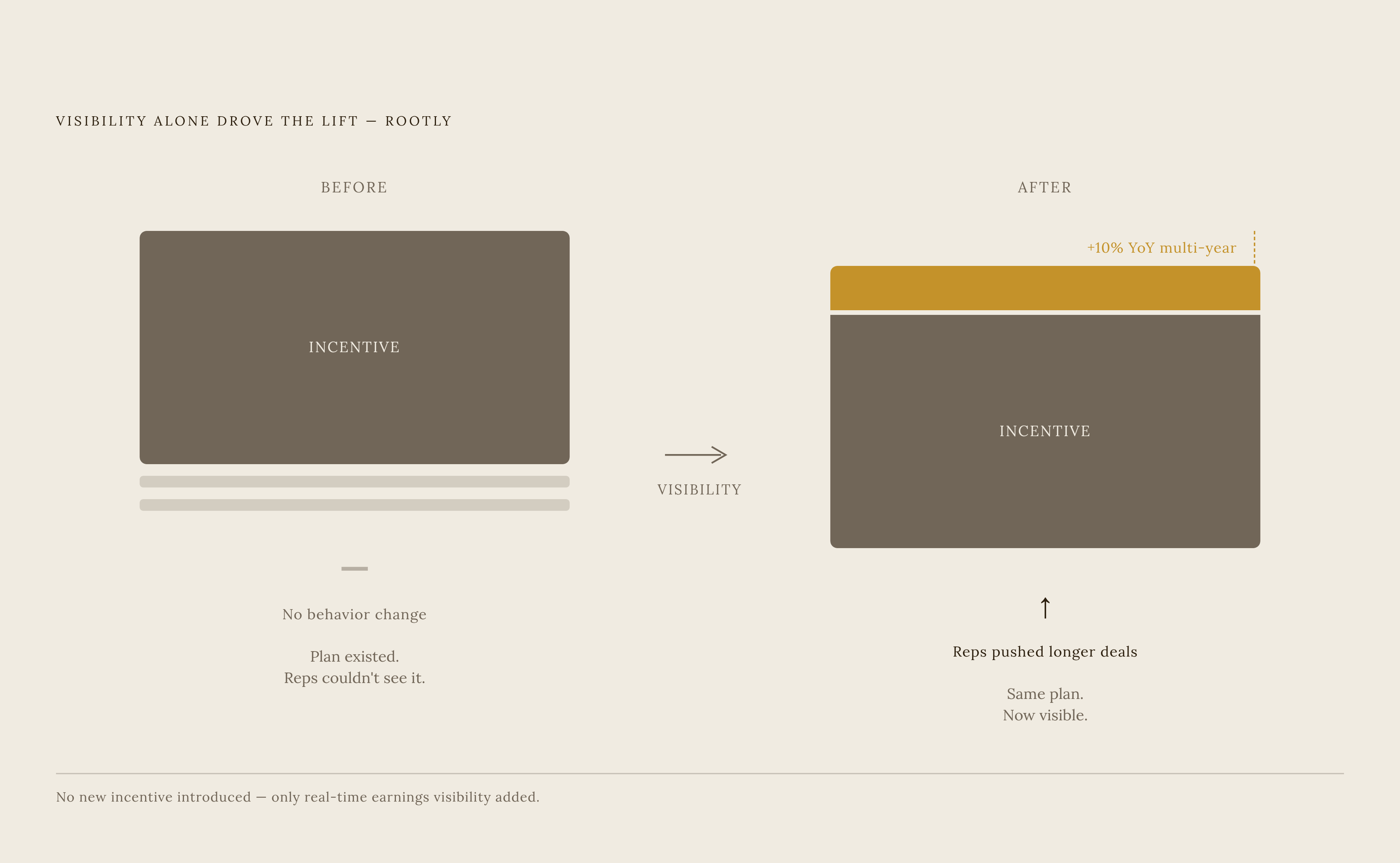
Rootly, an incident management platform, saw something more specific happen once reps could see real-time earnings: they started pushing for longer contracts on their own, without being told to. Andre King, Rootly's Director of Sales, described the shift this way: "Visibility into their earnings has changed what the reps are pushing for… showing your reps how much more they can make on longer contracts changed how they sell." The incentive for multi-year deals had existed in the plan the whole time. Visibility is what switched it on, and Rootly logged a 10% year-over-year increase in multi-year agreements once reps could see the math for themselves.
Warmly, a revenue orchestration platform, scaled its sales team from 3 reps to more than 30, and its old spreadsheet system couldn't keep pace, operationally or in terms of rep confidence. Keegan Otter, Warmly's Head of Revenue, framed the outcome in terms of culture rather than mechanics alone: reps could see what they'd earn as they closed deals, and that visibility became the foundation of trust across a team growing faster than its old tools could track.
The retention math: what commission trust is worth in turnover terms
PayScale's Compensation Best Practices Report puts a number on what trust is worth: reps at companies with clear, achievable on-target earnings and genuine pay transparency are 59% less likely to leave than reps at companies with low pay transparency. That improvement makes commission visibility a retention lever in its own right.
Turnover among sales reps costs far more than the price of posting a new job listing. A rep who leaves takes client relationships, pipeline momentum, and months of institutional knowledge along. New hires need meaningful ramp time before reaching full productivity, and during that stretch, managers get pulled away from coaching the reps who stayed and toward recruiting and onboarding instead.
The 83% figure on reps leaving over inaccurate commissions belongs here too, because it draws a straight line from opacity to departure instead of treating trust as an abstract morale issue. Retention doesn't improve just because base salary goes up. It requires that reps trust the system governing their variable pay, and a well-designed compensation plan that reps can't see or verify does nearly as much damage as a badly designed one they can see clearly. Design without visibility is design that never gets credited.
The visibility spreadsheets cannot deliver for retention and motivation
Spreadsheets remain the default tool for a striking share of companies, and that's the root of most of the trust problems described above. Commissionly's research found that more than 60% of SMBs still manage commissions this way, and Fullcast's research found only 27% of companies have fully automated their end-to-end commission process. A majority of sales organizations are running at least one manual step somewhere in the chain, and that step is usually where the trust breaks.
Manual processes generate manual errors structurally, not occasionally. Commission errors affect an average of 8.8% of payouts every year, which is what happens when tiered rates, accelerators, and splits get run through a tool that was never built to hold that much logic at once. Disconnected CRM, ERP, and commission systems make data mismatches close to inevitable, and reconciling all of it by hand can take up to six weeks. A six-week lag doesn't just delay a payout. It kills the real-time signal that motivation depends on. The spreadsheet is a different tool solving a different problem, and no amount of formatting fixes that mismatch.
What commission software needs to do to replace the spreadsheet
Replacing a spreadsheet isn't about running the same process faster. A rep needs to see, at any moment, what they've earned and what they stand to earn if a specific deal closes, tied to actual plan logic rather than a rough approximation or a monthly snapshot.
CRM integration isn't optional here: manual data entry is the single biggest source of commission errors, and a platform has to pull deal data automatically from the CRM instead of asking someone to re-key it into a separate system. Scenario modeling matters just as much. Reps should be able to model what different deal sizes, structures, or contract lengths mean for their own earnings before they close, and that's the mechanism that turns visibility from passive information into active sales strategy. Even accurate systems generate honest questions. A built-in, auditable dispute workflow has to resolve those questions and document the resolution, rather than letting the conversation scatter across Slack threads and email chains nobody can trace six months later.
How commission plan design either amplifies or undermines visibility
Run a simple test: can a rep explain how they get paid in under a minute? If not, the plan is too complicated, no matter how polished the dashboard sitting on top of it looks. A dashboard displaying a calculation nobody can follow is just a better-looking version of the same confusion, and calling that transparency doesn't make it so.
Certain design choices interact directly with visibility, for better or worse. Tiered rates and accelerators become genuine motivators once reps can see, in real time, how close they are to the next tier; buried in a spreadsheet, that same structure just sits there, invisible and inert. Capped commissions protect budgets, but they reliably demotivate top performers, and visibility sharpens that effect rather than softening it: once a high performer sees they've hit the ceiling early in the quarter, that cap becomes the single most visible number on their screen. Rootly's multi-year incentive shows the opposite case: an incentive that existed all along but only started driving behavior once reps could see it clearly. Residual commissions in subscription businesses follow the same logic, rewarding renewals in a way a real-time dashboard makes tangible instead of theoretical.
Different roles need different views, too. An SDR's plan doesn't look like an AE's, and a manager's doesn't look like either, so one undifferentiated dashboard serving a team with three distinct plan structures ends up serving none of them well. The build sequence that actually works starts upstream of the dashboard: set the business goals and KPIs first, choose the on-target earnings and pay mix, set quotas that are realistic rather than aspirational, and only then calculate the commission rate by dividing target variable pay by quota. Get that order backward, building the dashboard before the plan logic is sound, and no amount of visibility will fix a plan that was never clear to begin with.
Evaluating commission platforms: what to look for when visibility is the priority
Most vendors market "automation," but automation that just speeds up a monthly batch process still leaves reps without deal-level visibility at the moment it would actually matter. Evaluating a platform properly means asking what a rep sees, when they see it, and how much detail sits underneath it, not whether a vendor uses the word "real-time" in its pitch deck.
A few criteria separate real visibility from a faster version of the old opacity. Can a rep see current earnings, quota progress, and deal-level statement detail without asking finance for it? Can a rep model what a pending deal is worth before it closes, not after? Does data flow automatically from closed-won in the CRM, or does someone still re-enter it by hand? Can the platform handle tiered rates, accelerators, SPIFs, clawbacks, and splits without manual workarounds bolted on afterward, and when a rep has a question, is there a structured, auditable path to raise it, rather than a Slack channel nobody archives?
Finance needs its own guarantees running alongside the rep experience: the ability to lock a pay period, log approvals, and keep an audit trail that holds up under scrutiny. A platform that gives reps a clear window into their earnings but gives finance no equivalent control is just relocating the mistrust from one department to another. The goal is a system where both sides look at the same number, at the same time, with no reconciliation required afterward.